
Summary
Boat lettering works best for clean names, hailing ports, registration numbers, and simple identification, while boat decals better support logos, illustrations, gradients, and detailed multicolor graphics. Many vessels use both, but the right choice depends on the design, surface condition, placement, legal requirements, and installation method. A scaled proof and accurate measurements help the final graphic remain readable, balanced, and suited to the boat.
When comparing boat decals vs boat lettering, choose lettering for clean names, hailing ports, registration numbers, and simple identification. Boat decals better support logos, illustrations, gradients, textures, and detailed multicolor artwork. However, the categories can overlap because a printed boat name may function as both lettering and a decal.
Your choice should reflect the design, surface, viewing distance, legal requirements, and installation method.
Quick Summary
- Choose vinyl lettering when words or numbers form the main design.
- Choose custom boat decals for logos, illustrations, gradients, and detailed graphics.
- Many vessels combine lettering and decals to create a complete visual identity.
- Check the surface, placement, measurements, and applicable regulations before production.
Written by the Vintage Multimedia Team
Vintage Marine Graphics specializes in marine lettering, printed decals, original artwork, and custom fabrication. Founder Kim Sutton lettered his first boat at age 16. His experience spans nearly five decades of painted, vinyl, printed, stainless, and illuminated marine work.
That background supports a vessel-specific design process. The team reviews the hull, transom, available space, surface, and viewing distance before recommending a material. Vintage Marine Graphics works with boat owners, captains, builders, and boatyards seeking balanced designs and marine-suitable materials.
What Is the Difference Between Boat Decals and Boat Lettering?
Boat lettering describes words and numbers used for a vessel’s name, identification, or branding. It may be produced with cut vinyl, printed vinyl, paint, stainless steel, or other materials.
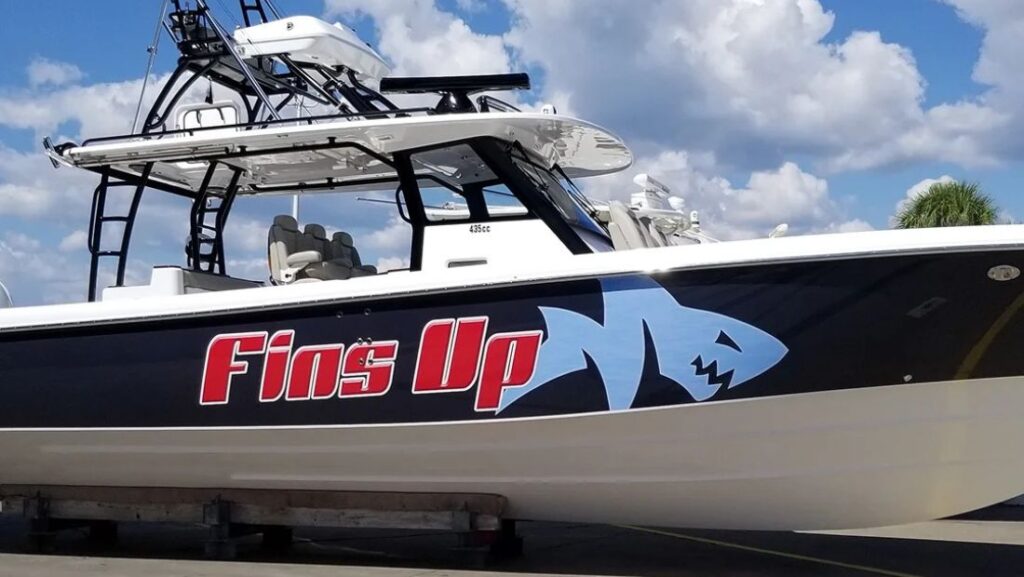
In this comparison, boat lettering refers mainly to pre-spaced cut-vinyl lettering, while boat decals refer mainly to printed adhesive graphics containing artwork, gradients, textures, or several colors.
| Feature | Typical cut-vinyl lettering | Typical printed boat decal |
| Best for | Names, hailing ports, numbers, simple identification | Logos, illustrations, patterns, detailed branding |
| Production | Characters cut from solid vinyl | Artwork printed onto adhesive film |
| Color options | Solid or layered colors | Full color, gradients, shading, and textures |
| Installation | Applied with transfer tape | Applied from backing as one graphic or several panels |
| Background | Hull remains visible between characters | May use clear, colored, or contour-cut areas |
| Main limitation | Less suitable for complex artwork | Fine details may disappear at small sizes |
Why Do the Terms Overlap?
“Lettering” describes the design content, while “decal” often describes the finished product. Therefore, a printed custom boat name can count as both lettering and a decal.
When Is Boat Lettering the Better Choice?
Boat lettering makes sense when words or numbers carry the main message. Common uses include a boat name, hailing port, registration number, charter phone number, or company identification.
Cut vinyl creates clean edges without adding a printed background around each character. It also suits owners who prefer simple colors and clear typography. Vintage Marine Graphics custom-fits names and identification to each vessel’s scale and placement area.
Does Vinyl Lettering Limit Your Colors?
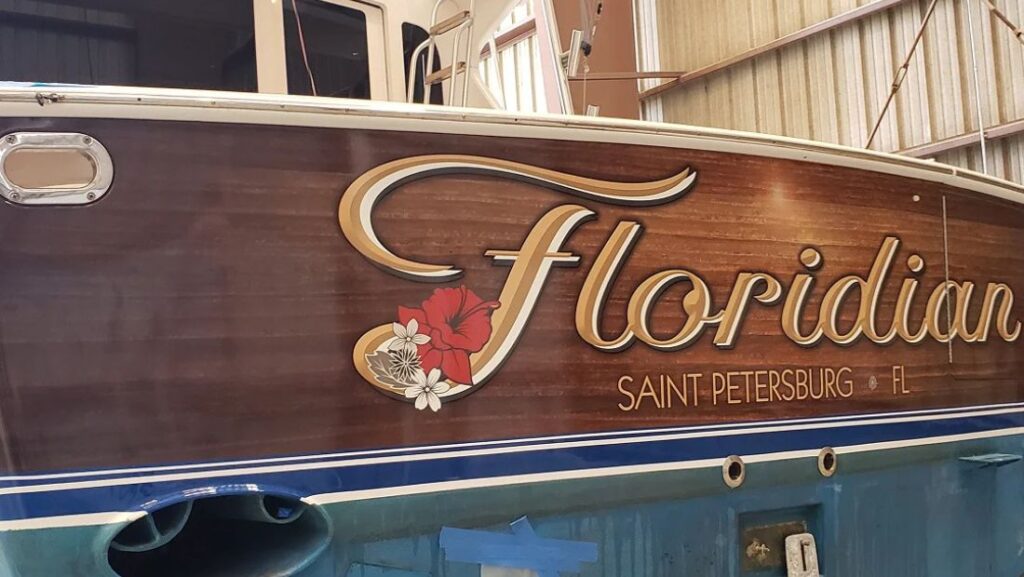
Solid vinyl depends on the colors and finishes available within the selected film series. Layering can add an outline, shadow, or secondary color.
However, several layers may increase thickness and production time. Printed lettering often handles intricate color effects more efficiently.
When Are Custom Boat Decals the Better Choice?
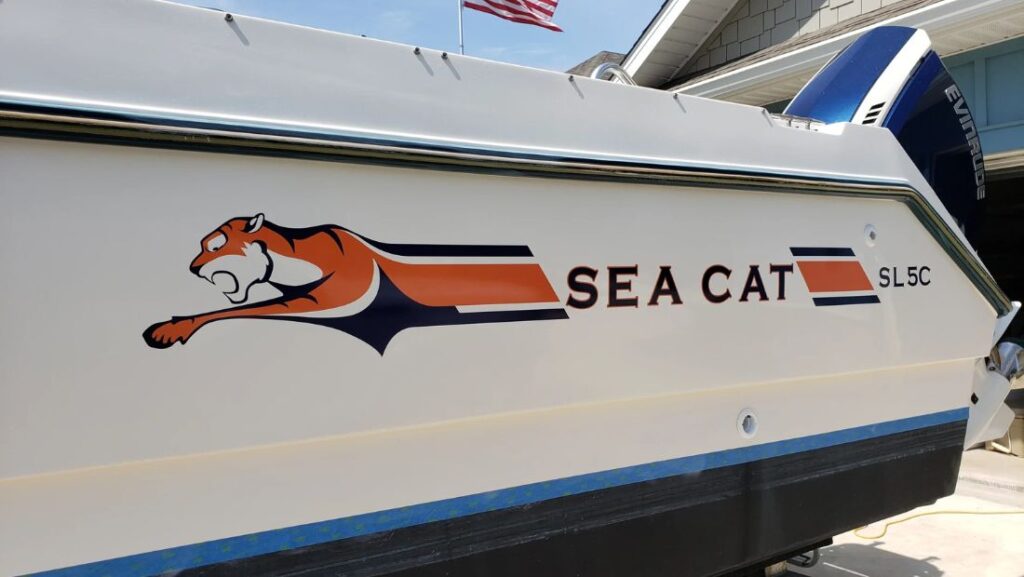
Custom boat decals suit logos, illustrations, sponsorship graphics, decorative marks, and detailed branding. They keep complicated artwork together as one controlled composition.
For example, a fishing vessel may need a marlin illustration beside its name. A printed decal can preserve shading, scales, water effects, and small color changes. VMG offers printed decals for names, logos, identification, and detailed artwork.
Are Boat Stickers and Boat Decals the Same?
Customers often use “boat stickers” and “boat decals” interchangeably. However, material quality can vary by film, adhesive, ink, laminate, and intended surface.
A decorative sticker does not automatically offer the same suitability as a specified marine graphic system. Ask which materials the company plans to use.
Can One Vessel Use Lettering and Decals Together?
Yes. Many effective vessel designs combine lettering and decals because each format handles a different task.
A charter boat may use solid vinyl lettering for its hailing port and contact details. Its logo may use a printed decal with several colors. Boat striping can then connect those colors across the hull.
What About Boat Wraps and Larger Graphics?
Boat wraps and large-scale graphics cover more surface than standard decals. They can transform a hull section, support commercial branding, or add performance styling.
A partial wrap may also complement smaller lettering without covering the entire boat. VMG offers printed graphics, vinyl graphics, striping, and partial wraps designed around vessel surfaces.
How Do Registration Numbers Affect the Choice?
Boat registration numbers serve an official identification purpose. Therefore, state rules may limit their size, spacing, placement, color, and character style.
Florida requires registration numbers on both sides of the forward half above the waterline. The state also requires contrasting block characters at least three inches high. For an undocumented vessel, the state-issued validation decal must appear on the port side within six inches before or after the registration number.
For detailed instructions, review the Florida boat registration number requirements.
Are Registration Decals Custom Decals?
No. A government agency issues registration decals or registration stickers. They confirm the vessel’s current registration period.
A graphics company can produce the displayed registration numbers. However, it cannot replace the official state-issued decal.
What Rules Apply to a Vessel Name and Hailing Port?
A vessel documented exclusively for recreation must display its name and hailing port together on a clearly visible exterior part of the hull. Under the federal vessel name and hailing-port requirements, the markings must remain durable and clearly legible.
Each character must measure at least four inches high. Therefore, confirm the boat’s documentation status before approving the final design.
Is the Hailing Port the Boat’s Current Marina?
Not necessarily. A hailing port serves a federal documentation purpose. It does not simply identify the marina where the boat currently stays.
Does the Boat Surface Change the Recommendation?
Yes. The surface may determine whether lettering or a decal will adhere correctly. Smooth, stable gelcoat, compatible paint, and suitable aluminum often provide workable installation areas.
Wax, oxidation, moisture, loose paint, and surface dirt can weaken adhesion. The 3M Watercraft Application Bulletin explains the surface inspection, cleaning, product selection, and installation requirements for its approved watercraft graphic systems.
Product compatibility remains material-specific. Therefore, confirm the exact hull surface and selected film before production.
What About Inflatable Boats?
Inflatable boats use flexible materials that may not accept standard adhesive vinyl. Stretching, folding, and changing air pressure can stress the graphic.
Choose only a product specifically designed for the inflatable material. Confirm compatibility before ordering or installing anything.
What About Personal Watercraft and Pontoon Boats?
A Jet Ski, Sea-Doo, or other personal watercraft may include textured panels and tight compound curves. These features can limit suitable placement areas.
A pontoon boat may have aluminum panels, seams, rails, and oxidation. Inspect the available surface before producing the design.
Which Option Is Easier to Install?
Small, pre-spaced vinyl lettering is often easier to position than a large printed decal. Transfer tape keeps each character aligned while you remove the backing.
A small decal may also be manageable. However, large one-piece graphics can trap air or distort across curves. Professional installation becomes more useful as the design or surface grows more complicated.
How Do Masking Tape and Painter’s Tape Help?
Low-tack masking tape or painter’s tape can hold the layout temporarily. Installers often create a center hinge before removing the backing.
Test the tape on a hidden area when the paint or finish appears weak.
Does Temperature Affect Installation?
Yes. Every vinyl product has an approved application temperature range. Follow the current manufacturer bulletin for the selected material.
For the approved watercraft films covered by its bulletin, 3M requires the air and watercraft surface to remain above 60°F and no higher than 90°F during application. Temperatures outside that range may affect positioning and initial adhesion.
How Should Font and Color Influence Your Choice?
Choose lettering when the font remains clean in solid or layered vinyl. Select a printed decal when the design needs textures, blended colors, or artwork inside the letters.
Readability should guide both options. Thin custom fonts may look attractive on a design tool but disappear across a marina. Detailed decals can also lose clarity after reduction.
Can Reflective Material Work on a Boat?
Reflective vinyl may suit selected accents or identification. However, direct sun, glare, and nighttime lighting can change its appearance. Test a sample under the boat’s expected viewing conditions before production.
Which Option Lasts Longer?
Neither option automatically lasts longer. Service life depends on the exact film, adhesive, ink, laminate, exposure, installation, and maintenance.
Sun, salt, abrasion, storage, and surface preparation can change performance. Avoid broad durability promises based only on the phrase “marine grade.”
Can Boat Decals Go Below the Waterline?
Do not assume standard vinyl supports continuous submersion. Check the technical bulletin for the selected graphic system.
How Should You Maintain Lettering and Decals?
Rinse away salt and surface dirt using fresh water. Clean gently with products approved for the boat finish and installed vinyl.
Avoid abrasive tools and aggressive pressure near exposed edges. Avoid directing high-pressure water at exposed graphic edges because it may cause lifting or damage.
Can You Wax Over Boat Graphics?
Check the film manufacturer’s maintenance instructions before applying wax or polish. Certain products may change the finish or collect around edges.
More importantly, remove existing marine wax before installation. Manufacturer guidance warns that wax residue can greatly reduce graphic adhesion.
How Much Do Boat Decals and Lettering Cost?
Simple vinyl lettering usually requires less production than detailed printed artwork. However, price also depends on size, colors, font, material, preparation, and installation access.
Custom decals may require artwork preparation, color matching, contour cutting, laminate, or several panels. Removal, repairs, difficult access, and short production timelines can also affect the quote.
Which Option Provides Better Value?
Lettering often provides better value for clean names and identification. Decals provide better value when complex artwork would require several separate vinyl layers.
Compare the material system, design support, proofing process, and installation plan instead of choosing by price alone.
How Do You Choose Between Boat Decals vs Boat Lettering?
Choose based on the design’s main purpose rather than the product name. Lettering handles clean words and numbers, while decals handle detailed artwork.
Follow these steps before placing an order:
- Identify the content. Choose lettering for clean text and decals for detailed graphics.
- Check the rules. Confirm state or federal marking requirements before styling official information.
- Inspect the surface. Review paint, gelcoat, aluminum, curves, wax, and oxidation.
- Measure the space. Record usable width and height around rails, vents, doors, and hardware.
- Review a scaled proof. Check contrast, spacing, detail, and visibility before production.
For example, a charter vessel may need cut lettering for its hailing port and phone number. A printed logo can carry its detailed brand artwork.
What Should You Send Before Ordering?
Accurate project details help the designer recommend lettering, a decal, or a combined system. Wider vessel photos reveal proportion, while straight-on photos support accurate placement.
Prepare the following:
- Exact boat name, registration number, hailing port, or company wording
- Straight-on and wider photographs of the vessel
- Available width and height around nearby hardware
- Hull material, color, finish, and known surface problems
- Preferred font, colors, logo files, and design references
- Installation location, shipping needs, and preferred completion date
For a straightforward name or number, use Order Lettering With Design Support. For detailed graphics or original artwork, use Start My Design.
What Common Mistakes Should You Avoid?
Do not approve the artwork before checking the actual installation area. A close-up photo may hide curves, vents, ladders, doors, or limited space.
Another mistake involves forcing detailed artwork into cut vinyl. Customers may also choose printed lettering when solid cut vinyl would create a cleaner result.
When Is a Decal Too Detailed?
Fine lines and narrow gaps can disappear when the artwork reaches production size. Simplify the graphic or increase its dimensions.
Review the design at its intended size rather than using a heavily enlarged screen preview.
Frequently Asked Questions About Boat Decals vs Boat Lettering
Can a Boat Decal Be Cut Around the Artwork?
Yes. A printed decal may be contour-cut around the artwork so it does not need a large rectangular background. The available detail and cut shape depend on the design, size, material, and production method.
Do Vinyl Letters Need Transfer Tape?
Pre-spaced cut vinyl usually uses transfer tape. It keeps every character aligned while the installer removes the backing and applies the layout.
Can You Install Boat Decals Over Wax?
No. Wax can weaken adhesion and cause early lifting. Remove wax, contamination, and surface dirt before installation.
Can You Remove Vinyl Lettering Later?
Many vinyl products can be removed with controlled heat and suitable tools. Results depend on the material, age, surface, and underlying paint condition.
Expert Tip: Check the Design Without Zooming In
Print the design at its intended size or place a scaled proof over a straight-on boat photo. Then inspect it from the expected dock distance.
Small details that look clear on a screen may disappear on the vessel. This check also reveals weak contrast and crowded spacing.
Start Your Boat Lettering or Decal Project
Boat lettering works well for clean names, numbers, and hailing ports. Printed decals provide more flexibility for logos, illustrations, gradients, and detailed visual effects. Many vessels use both to create a complete design.
Send Vintage Marine Graphics your vessel photos, measurements, exact wording, and available artwork. The team can review the surface and design requirements before recommending cut lettering, printed decals, or a combined system.
Start with Marine Lettering and Identification or submit a larger custom project through Start My Design. For additional help with names, materials, numbers, and placement, read the custom boat lettering guide.