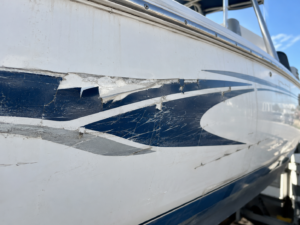

There is no single letter height that works for every boat. We size the complete boat name around the usable space on the transom or hull, the font, the number of characters, viewing distance, outboards, hardware, and any hailing-port requirements. A 30-foot boat with triple outboards may have less usable lettering space than a smaller boat with a clear transom, so boat length alone should never determine the finished size.
Quick Summary
- Measure the usable lettering area, not the entire transom.
- Size the whole boat name before deciding how tall each letter should be.
- Font width, capital letters, lowercase letters, outlines, and dimensional materials all change the finished footprint.
- Keep decorative boat-name sizing separate from legal rules for documented vessels and Florida registration numbers.
Written by the Vintage Marine Graphics Team
At Vintage Marine Graphics, we design marine lettering around the actual vessel rather than forcing every boat name into a standard template. Founder Kim Sutton lettered his first boat at age 16 and has worked in marine lettering and graphics for nearly five decades.
Our work includes custom boat names, vinyl lettering, registration numbers, stainless steel lettering, illuminated lettering, and original marine artwork. Each project starts with the boat, its available space, and the intended appearance.
Start With Usable Transom Width, Not Boat Length
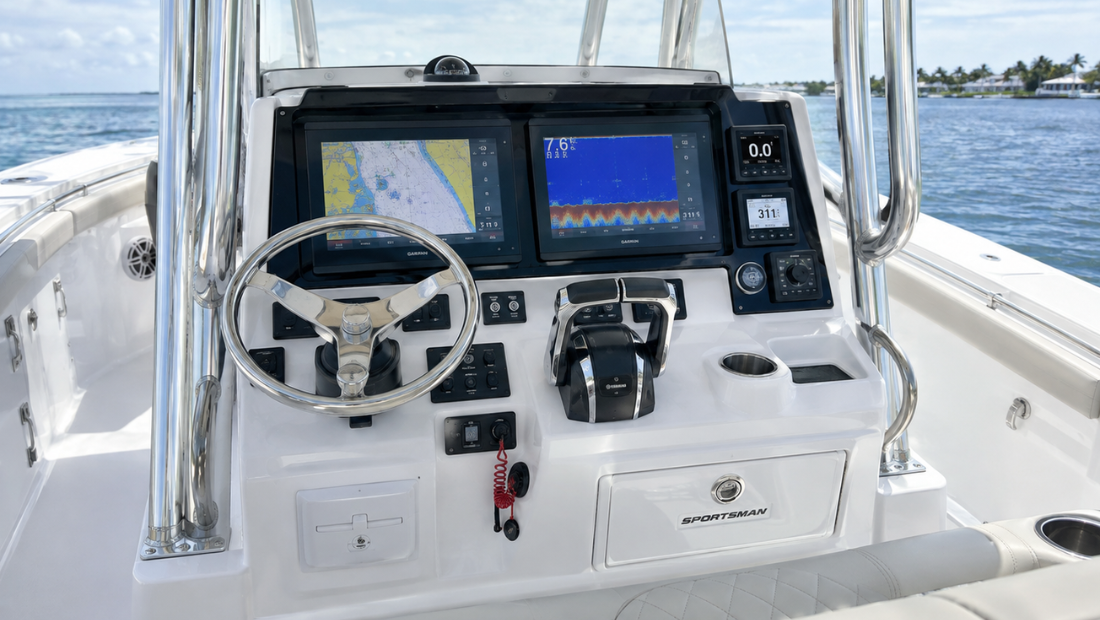
The best starting point is the actual area where the finished boat name can fit comfortably. Center consoles make this especially important. Twin, triple, or quad outboards can occupy much of the stern. Boarding doors, swim ladders, hinges, vents, rod holders, trim, transom seams, and access panels can reduce the usable width even further.
That is why we do not recommend choosing a letter height from boat length alone. A “30-foot center console” does not tell us enough about the space available for the lettering.
Instead, we look at:
- Maximum usable width
- Maximum usable height
- Location of engines and hardware
- Boat-name length
- Font proportions
- Whether a hailing port will appear with the name
- Whether the lettering is vinyl, stainless, illuminated, or another material
- How the name should look from normal dock viewing distance
Our boat name design service is built around this vessel-specific approach. VMG designs boat names to fit the boat’s proportions, transom, hull sides, and curved surfaces rather than selecting a generic preset size.
How Do You Measure a Center Console for Boat Name Lettering?
Measure the clear area first, then design the lettering inside it.
1. Measure the Maximum Usable Width
Use a tape measure across the section where you want the boat name. Do not measure from one outside edge of the transom to the other if engines, hatches, trim, or hardware interrupt that space. Measure only the area the finished product can actually occupy.
For example, a transom may be 80 inches wide overall but provide only 48 inches of uninterrupted space above or beside the outboards. That 48-inch dimension is the useful number for the design.
2. Measure the Available Height
Next, measure vertically between any edges, moldings, doors, platforms, lights, or other obstructions. Height matters because the final size is controlled by the entire word, not simply the height of a capital letter.
A custom font with a lowercase “g,” “y,” or “p” may extend below the baseline. Tall capital letters, swashes, shadows, outlines, or a second line for the hailing port can also increase the actual size of the layout.
3. Take a Straight-On Photo
A straight-on photo helps us understand proportion and location better than measurements alone. Include enough of the stern to show the outboards, swim platform, transom door, hardware, and surrounding hull. A known measurement in the photo gives us a reference for scale.
4. Mark the Proposed Area With Painter’s Tape
Painter’s tape can help you visualize the maximum width and height before anything is ordered or installed. Tape the approximate outline onto the boat, then step back. Looking at the space from the dock often gives you a better idea of whether the name feels crowded, undersized, or appropriately proportioned.
Why the Font Changes the Boat Name Letter Size
Two boat names with the same letter height can have completely different finished dimensions. A narrow custom font can fit a longer name into the available space. A wide script or bold block style may require much more width. Lowercase letters also have different proportions from all caps.
Consider these examples:
| Design Factor | How It Affects Size | What to Check |
| All capital letters | Often creates a taller, more uniform layout | Total width and spacing |
| Upper- and lowercase lettering | May include ascenders and descenders | Actual overall height |
| Script font | Can extend beyond individual letter boundaries | Swashes and connecting strokes |
| Bold block font | Uses more visual mass | Width and spacing |
| Outline or shadow | Makes the graphic larger than the base letters | Finished outer dimensions |
| Long boat name | May require reduced height or a narrower font | Total usable width |
This is why simply saying “I want 8-inch letters” can create problems. Eight-inch letters in one font may produce a very different finished width than eight-inch letters in another. We prefer to establish the finished width and height of the complete name, then judge whether the proportions suit the boat.
How Much of the Transom Should the Name Fill?
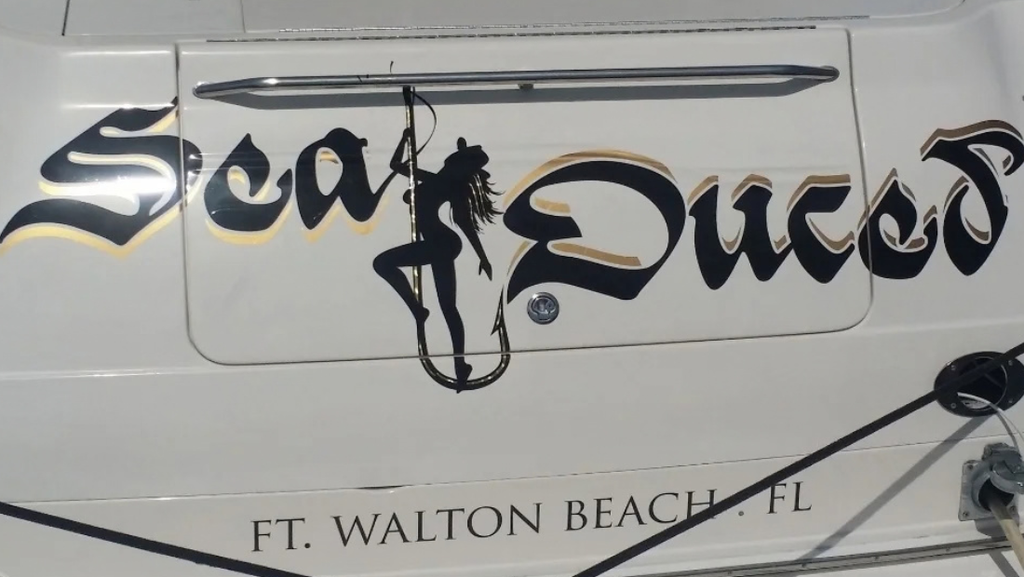
The name should feel intentionally sized without appearing squeezed between the edges and hardware. There is no universal percentage that works for every center console. Instead, we leave enough surrounding space so the lettering feels separate from engines, trim, doors, and other visual elements.
A short boat name may need larger letters to create enough presence. A long name may need smaller letters, tighter but still readable spacing, or a different font.
For example, the word REEL and a name such as SECOND CHANCE could occupy the same available transom width but require very different letter heights. The better idea is to compare the whole composition at scale, not choose letter size independently.
What If Twin or Triple Outboards Take Up Most of the Stern?
Do not force the name into a crowded transom just because the stern is the traditional location. Center consoles often have limited uninterrupted space because of outboards and rigging. Depending on the vessel, a boat name may work above the engines, on a clear stern section, or on the hull sides near the stern.
We evaluate the boat’s lines and practical installation area before choosing the final location. Our marine lettering and identification service specifically adjusts letter size, spacing, font style, and placement around the vessel’s proportions.
Check Engine Movement and Access
The lettering should not interfere visually or physically with equipment that needs to move or open. Before approving the location, check:
- Outboard steering and tilt clearance
- Transom doors
- Hatches and access panels
- Swim ladders
- Hinges and latches
- Vents
- Molded edges and seams
A name that looks centered in a flat design file may not feel centered once the engines and hardware are considered.
Boat Name Size Is Not the Same as Registration Number Size
This distinction matters because boat owners often mix decorative boat lettering with required identification markings.
Federally Documented Recreational Vessels
For a recreational vessel documented with the U.S. Coast Guard, federal rules require the vessel name and hailing port to be marked together on a clearly visible exterior part of the hull. The required markings must use clearly legible characters at least four inches high. You can review the current federal requirement in 46 CFR § 67.123.
That minimum is a compliance requirement, not a recommendation that every center-console boat name should be exactly four inches tall. Your design may need to be larger for proportion and readability.
Florida Registration Numbers
Florida registration numbers follow a different rule. The law requires the assigned number on both sides of the forward half of the vessel, reading left to right, in block characters at least three inches high and in a contrasting solid color. See the current Florida vessel registration statute for the applicable requirements.
If you need those markings, our boat registration number service handles registration layouts separately from the decorative boat name.
Does the Lettering Material Change the Size?
Yes. The same artwork may need different spacing or scale depending on how it will be produced.
Vinyl Boat Lettering
Vinyl can work well for clean lettering, custom fonts, layered effects, and boat name decal-style applications. It allows detailed shapes without the physical depth of fabricated letters. Our custom vinyl boat lettering is sized specifically for the vessel rather than using off-the-shelf layouts.
Flat-Cut Stainless Steel
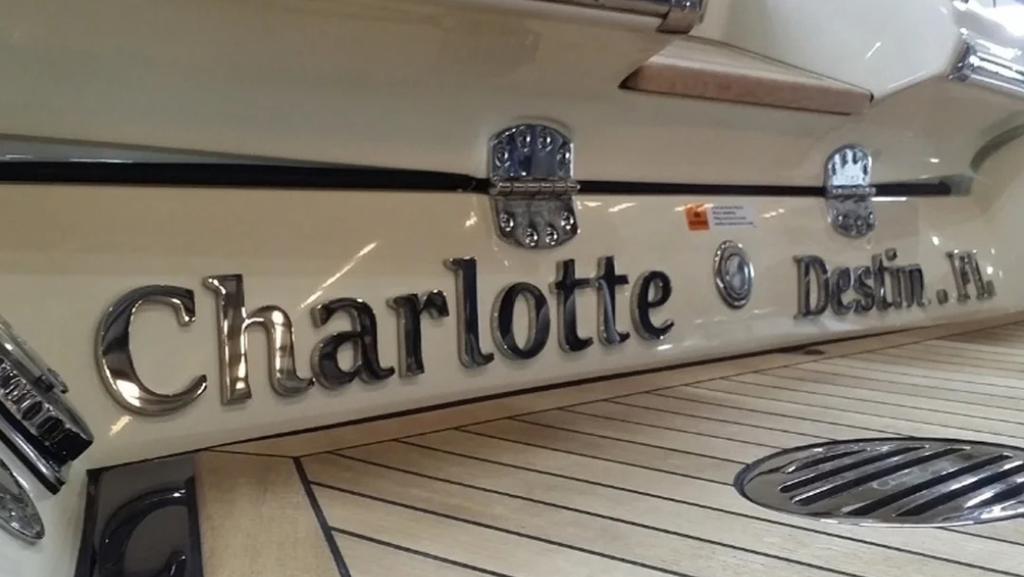
Dimensional stainless lettering introduces physical depth, individual letter spacing, edges, mounting requirements, and material weight. A design that works as vinyl may need adjustment before becoming stainless. VMG’s marine-grade 316 stainless steel lettering is laid out around vessel scale and surface curvature.
Illuminated Letters
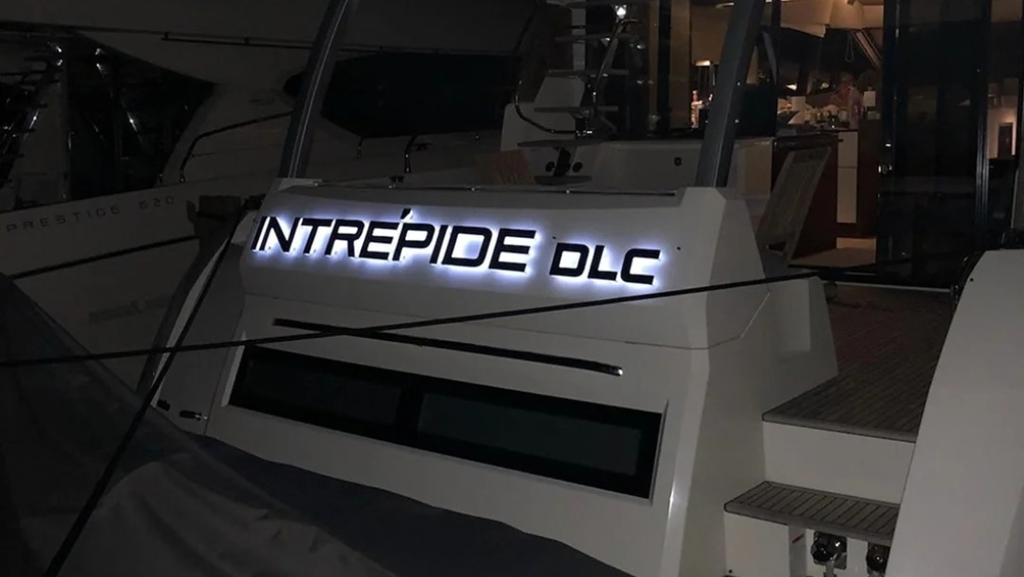
Illuminated stainless adds another layer because the design also needs room for the letter construction, lighting effect, wiring, spacing, and installation. Our illuminated stainless steel boat lettering is planned around stern layout, mounting surface, available power, and overall proportion.
What Boat Lettering Sizing Mistakes Should You Avoid?
The most common mistake is ordering by letter height before understanding the available space. Other sizing problems include:
- Measuring the whole stern instead of the usable lettering area
- Choosing size based only on boat length
- Forgetting the width of a long boat name
- Ignoring lowercase descenders or script flourishes
- Selecting a font that becomes difficult to read at the final scale
- Crowding lettering against engines, doors, trim, or hull edges
- Treating registration numbers and a decorative boat name as the same requirement
- Approving a small screen preview without checking the design at a realistic scale
- Choosing material after the design has already been sized
A full-size paper print or properly scaled proof can reveal spacing problems before production begins.\
What Should You Send Us Before We Size Your Boat Name?
We can give you better sizing guidance when we can see the boat and understand the available space. Before beginning the ordering process, send:
- The exact boat name
- A straight-on photo of the stern or proposed location
- Maximum usable width
- Maximum usable height
- Boat make, model, and approximate length
- Your preferred lettering style or custom font
- Whether you want vinyl, stainless, illuminated lettering, or another finish
- Your hailing port if the vessel is federally documented
- Any specific hardware or installation concerns
That gives us enough context to create a layout at the correct scale rather than guessing from boat length alone.
FAQs
Is there a standard boat name letter size for a center console?
No. There is no single standard decorative size that fits every center console. We recommend sizing the complete boat name around the usable lettering area, font, hardware, and viewing distance.
Should I measure letter height or total name width first?
Start with the total usable width and height of the installation area. Once we know that space, we can determine the appropriate letter height for the specific font and boat name.
Can the boat name go on the hull side instead of the transom?
Yes, depending on the boat and the applicable identification requirements. For federally documented recreational vessels, make sure the name and hailing port arrangement complies with the current federal marking rules.
Should the hailing port be smaller than the boat name?
It can be visually smaller in some layouts, but federally documented recreational vessels must still meet the federal minimum character-height requirement for the required markings. Check the current rule before approving production.
Expert Tip
Before approving the finished product, ask for a scaled layout based on a straight-on boat photo and at least one known measurement. Compare the design against the engines, transom hardware, and hull edges, not just the empty space around the text.
Size the Name to the Boat, Not to a Generic Chart
What size should boat name letters be on a center console? The right size is the one that fits the usable area, stays readable, and looks proportionate to the vessel. Boat length can provide context, but the transom layout, outboards, font, name length, material, and legal marking requirements ultimately determine the finished dimensions.
Send us your boat photo, measurements, boat name, and preferred style through Start My Design. We can use those details to build the lettering around your actual center console instead of relying on a generic size chart. Now that you know how to size the name, review our custom boat lettering guide to compare lettering materials, names, numbers, and decals before making your final choice.