
A Florida boat registration numbers lookup can help you locate vessel records, verify registration details, and check important information before buying or transferring a boat. The right search method depends on the information you have and what you need to confirm.
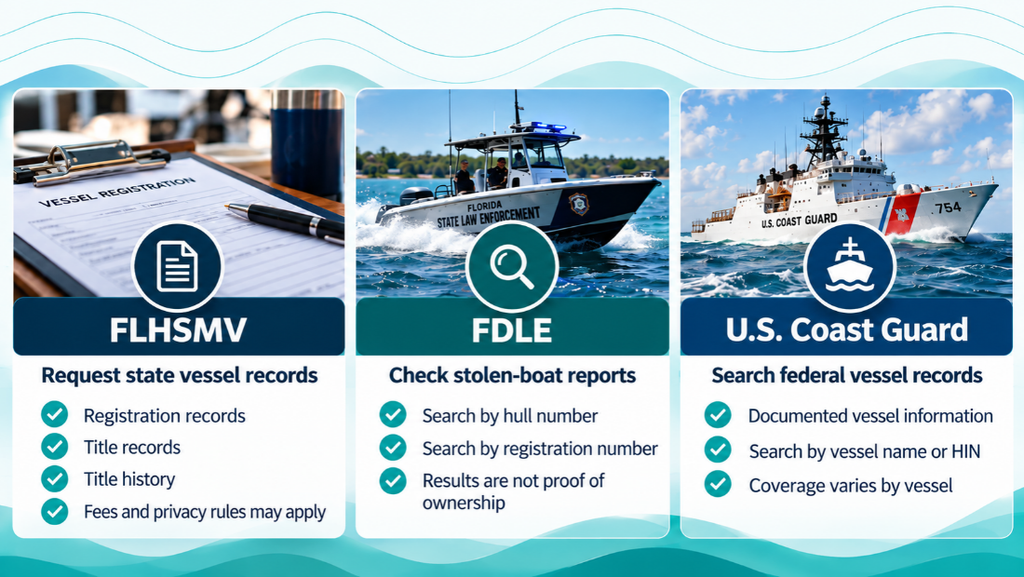
You can request Florida vessel registration and title records through the Florida Department of Highway Safety and Motor Vehicles (FLHSMV), check reported stolen boats through the Florida Department of Law Enforcement (FDLE), or search certain vessel records through the U.S. Coast Guard. Each resource provides different information, and access to personal ownership details may be restricted.
Quick Summary
- Florida vessel records: FLHSMV accepts official requests for vessel registration, title, and title-history information.
- Stolen boat checks: FDLE provides a public search for boats reported stolen in Florida.
- Documented vessels: The U.S. Coast Guard offers a separate search for certain vessel information.
- Ownership verification: A registration-number search alone cannot establish legal ownership or confirm that a vessel is free of liens.
Written by the Vintage Marine Graphics Team
At Vintage Marine Graphics, we work with boat owners on registration lettering, boat names, and marine identification. Our team understands why accurate vessel information matters when preparing new or replacement registration numbers.
We created this guide using information from Florida government agencies and the U.S. Coast Guard to help boat owners identify the appropriate records and understand the lookup process.
Where Can You Look Up Florida Boat Registration Numbers?
You can search or request Florida boat information through several official government resources. However, Florida does not provide one unrestricted public database that displays every registered boat and its owner’s personal information.
The best resource depends on whether you want to verify a registration, review title information, check a stolen-boat report, or research a federally documented vessel.
| Resource | What You Can Check | Important Limitation |
| Florida Department of Highway Safety and Motor Vehicles | Registration records, title records, and title history | Formal requests, fees, and privacy restrictions may apply |
| Florida Department of Law Enforcement | Whether a boat appears in Florida’s publicly searchable stolen-property records | Results are not proof of ownership or a final determination of theft |
| U.S. Coast Guard | Available federal vessel identification, documentation, and inspection records | Coverage varies by vessel and record type |
| County Tax Collector’s Office | Assistance with Florida vessel registration and title transactions | Not an unrestricted public ownership-search service |
Understanding these differences can save time, especially when you have only an FL number and want to identify the next step.
How to Look Up Florida Boat Registration Numbers Through FLHSMV
For state vessel records, FLHSMV is a primary source. The department maintains Florida vessel registration and title information and provides a formal process for requesting available records.
Step 1: Gather the Vessel Information
Before starting your search, collect as many identifying details as possible.
Useful information includes:
- Florida registration number, also called the FL number
- Hull identification number (HIN)
- Florida title number, if available
- Vessel manufacturer and model
- Boat length and year
- Existing registration certificate
- Bill of sale or other purchase documents
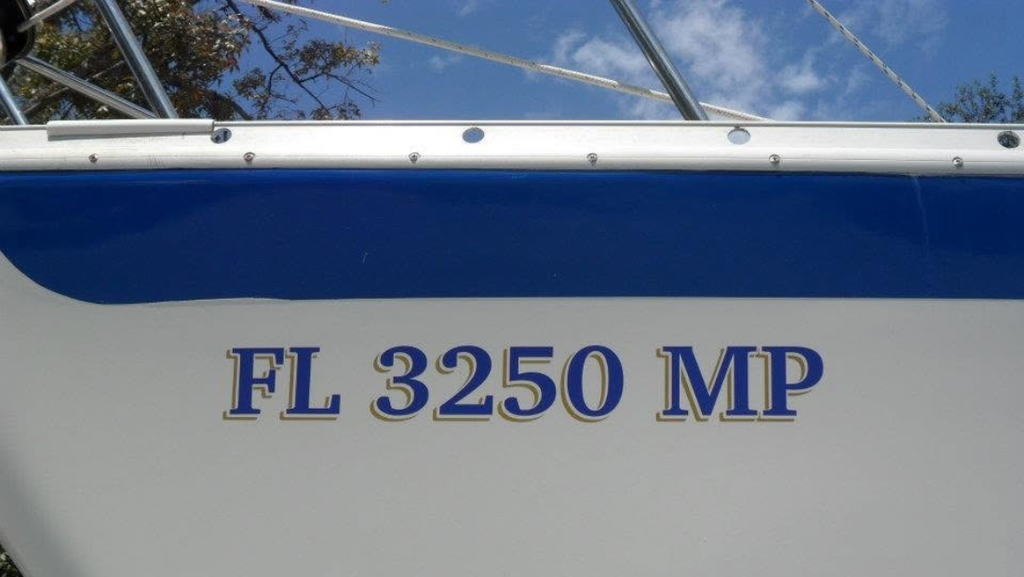
You may find the FL number displayed on the forward portion of the boat’s hull. The HIN is a separate identifier, commonly located on the starboard side of the transom.
If you own the vessel, check your registration certificate and title documents first. These records may provide the identifying details needed for a formal request.
Step 2: Request the Appropriate Florida Vessel Record
Florida provides Form HSMV 90510, titled Motor Vehicle, Vessel and Mobile Home Records Request. The form allows applicants to request different types of records, including current registration information and vessel title records.
You can access the official form here:
FLHSMV Motor Vehicle, Vessel and Mobile Home Records Request (Form HSMV 90510)
When completing the form, select the vessel record category and enter the available identification information. The type of record matters. A current registration request differs from a request for title history or a specific title transaction.
Step 3: Submit the Request and Pay Applicable Fees
FLHSMV’s records-request form explains the available record types, applicable fees, and submission requirements.
The department may charge different amounts depending on the records requested. Certified copies and more extensive title histories may involve additional charges.
The form also indicates that applicants should allow approximately two weeks for processing after the department receives the request. Actual turnaround may vary. Review the current form before submitting your application because fees and procedures can change.
Step 4: Review the Information You Receive
Once FLHSMV processes your request, review the information provided against the vessel’s existing documentation.
Depending on the record type and your eligibility to receive the information, the response may help you examine:
- Registration information
- Vessel identification details
- Title records
- Recorded title transactions
- Available lien information
- Registration or title history
Access to some information may be restricted under privacy laws. If the records differ from the seller’s documents, seek clarification from FLHSMV or the relevant county tax collector before completing a purchase.
How to Check Whether a Florida Boat Has Been Reported Stolen
The Florida Department of Law Enforcement offers a public stolen-boat search through its Florida Crime Information Center Public Access System.
This tool serves a different purpose from a registration or title lookup. It helps users search information about boats reported stolen to Florida law enforcement agencies.
Using the FDLE Stolen Boat Search
Visit the official FDLE Stolen Boat Search. The search accepts several identifiers, including:
- Boat hull number
- Boat registration number
- Owner-applied number
Enter the available number, complete the required verification, and submit the search. The database contains stolen-property information reported by law enforcement agencies and authorized for public release.
What the Results Mean
A matching record may indicate that the identifying information appears in Florida’s publicly available stolen-property database. However, FDLE warns that its results should not serve as the sole basis for legal action or a definitive conclusion that a boat is stolen.
Likewise, a search that produces no matching record does not guarantee that a vessel has never been stolen. The database depends on available reporting information, and some vessel identifiers may not be unique.
For a boat purchase, treat this search as one part of your research rather than a replacement for title verification.
How to Search U.S. Coast Guard Vessel Records
Some boats have federal documentation through the U.S. Coast Guard rather than relying exclusively on state vessel identification.
The Coast Guard maintains the Port State Information Exchange (PSIX), which allows users to search available vessel information.
Searching the Coast Guard Database
Visit the official U.S. Coast Guard PSIX Vessel Search.
Available search fields include:
- Vessel name
- Primary vessel number
- Hull identification number
- Vessel call sign
- Vessel flag
- Vessel service
- Vessel build year
Enter the information you know and review any matching records. Depending on the vessel, available records may include vessel particulars, documentation information, and Coast Guard activity.
What If the Boat Does Not Appear?
A missing result does not automatically mean the vessel lacks a valid registration or documentation. The PSIX system contains information drawn from Coast Guard records. Its coverage and the details available for each vessel depend on the information included in that system.
For federal documentation questions, the U.S. Coast Guard’s National Vessel Documentation Center provides additional records and assistance.
Florida’s state registration records and federal documentation records serve different purposes, so one search may not replace the other.
What Information Can You Find Using an FL Number?
An FL number can help identify the registration record associated with a state-registered Florida vessel. However, the information available depends on the government system, the record requested, and the applicant’s access rights.
A registration number may help you request certain vessel details, while title-specific research can require an HIN or title number.
Registration Details
An official registration record may help establish information about the vessel’s current registration, depending on what the agency can release. For your own boat, the registration certificate is often the simplest starting point.
Vessel Identification
Records may contain identifying information such as the manufacturer, model year, hull identification number, or vessel description. These details are particularly useful when checking whether paperwork corresponds to the boat being examined.
Ownership and Title Information
Title records can provide information relevant to ownership and past transactions. However, Florida restricts access to certain personal information. A member of the public cannot assume that entering an FL number will reveal the registered owner’s name, home address, or contact information.
Anyone needing ownership records should use the official request process and comply with applicable disclosure requirements.
Liens and Title History
Title research may help identify recorded liens or previous title transactions. For a potential purchaser, this information matters because a seller’s possession of a boat does not automatically establish that the title is clear.
Confirm the status of any recorded lien and request appropriate evidence of its satisfaction before completing the sale.
FL Number vs. Hull Identification Number: Which Should You Use?
A Florida registration number and a hull identification number serve different identification purposes. Knowing which one to use can help you avoid searching the wrong records.
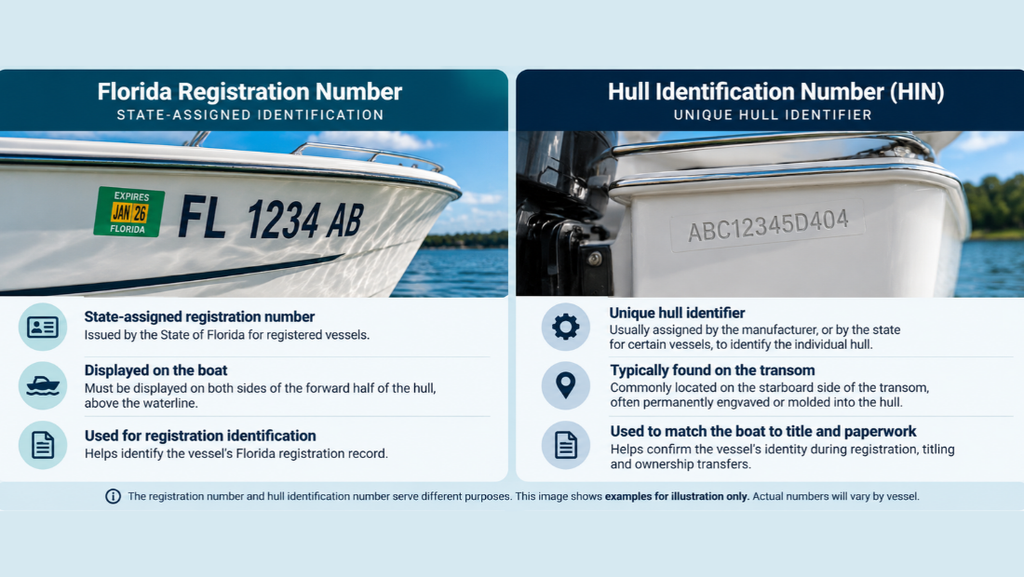
| Identification | Purpose | Common Location |
| Florida registration number | Identifies a vessel’s assigned state registration | Exterior of the forward half of the hull |
| Hull identification number (HIN) | Identifies the individual hull | Typically the starboard side of the transom, with a secondary location |
| Florida title number | Identifies a Florida title record | Vessel title documentation |
| USCG official number | Identifies a federally documented vessel | Federal documentation and permanent interior hull marking |
When to Use the FL Number
Use the FL number when requesting available Florida registration information or conducting an applicable registration-number search. The number generally begins with the letters FL, followed by its assigned characters.
When to Use the HIN
Use the hull identification number when a search or request specifically requires the boat’s manufacturer-assigned hull identity. The HIN is especially important when comparing a vessel with its title or purchase documents.
The original manufacturer generally assigns this identifier, while special procedures may apply to homemade vessels or vessels without a valid HIN.
A boat’s HIN and registration number should not be treated as interchangeable. For a detailed explanation of how Florida-assigned numbers must appear on the hull, see our Florida boat registration numbers guide.
Can You Find a Florida Boat Owner by Registration Number?
An FL number can help you request information about a vessel, but it does not guarantee access to the owner’s personal details. Florida maintains vessel title and registration records, but disclosure rules protect certain personal information.
Someone researching a boat might want to identify the owner for several reasons, including:
- Confirming a seller’s authority to sell
- Researching title history
- Investigating a possible ownership discrepancy
- Resolving a registration problem
- Requesting records for a legitimate legal or business purpose
In these situations, the appropriate approach is to request the relevant official record. If the purpose involves a boat purchase, ask the seller to provide the title, registration information, and other documentation needed to verify the transaction. Do not rely on an online search alone to establish legal ownership.
How to Verify Vessel Information Before Buying a Used Boat
A registration lookup can be useful when buying a used Florida boat. It allows you to compare the information provided by the seller with available government records.
We recommend focusing on the vessel’s identity, documentation, and title status rather than relying only on the registration numbers painted or affixed to the hull.
Compare the HIN With the Paperwork
Locate the hull identification number on the vessel and compare it with the HIN listed on the title and other available documents.
Look carefully for missing characters, alterations, or inconsistencies. If the numbers do not match, resolve the difference with the seller and the appropriate agency before proceeding.
Review the Title and Ownership Documents
Ask the seller for the appropriate title and registration paperwork.
Review the ownership information, title status, and any recorded liens. If the boat has multiple owners or a recorded lienholder, additional signatures or documentation may be necessary.
A bill of sale supports the transaction, but it does not automatically resolve title problems.
Check Available Stolen-Property Records
Use the FDLE search to check whether the vessel’s registration number or HIN appears in its stolen-boat records.
Treat the results as preliminary information and seek assistance from the appropriate authorities if you encounter a concerning match.
Confirm the Transfer Requirements
Before completing the purchase, determine which title and registration documents you need.
The county tax collector can help explain the applicable Florida transfer process.
This is particularly important for vessels with unusual title histories, homemade vessels, or boats previously registered in another state.
What If You Cannot Find the Boat’s Registration Information?
An unsuccessful lookup can happen for several reasons. The record may be unavailable through the selected system, the identifier may be incorrect, or the boat may fall under a different registration or documentation process.
The Registration Number May Be Incorrect
Check the letters and numbers carefully. A character may have been copied incorrectly from faded vinyl lettering or an old photograph. Compare the displayed number with the registration certificate whenever possible.
You May Be Searching the Wrong Database
State registration records and Coast Guard records are not identical. For example, Coast Guard-documented vessels use federal identification, although some must also maintain Florida registration. Choose the database that corresponds to the information you need.
The Vessel May Have a Different Registration Status
Certain nonmotorized boats are exempt from Florida’s general registration requirement, including qualifying kayaks, racing shells, and rowing sculls. Other categories, such as government vessels or federally documented vessels, may follow special rules. For motorized vessels, verify the applicable requirements rather than assuming an exemption applies.
The Ownership Records May Be Outdated
A recent sale or transfer may not yet appear in the available information. If you recently purchased the vessel, check the transaction status with the appropriate tax collector’s office. The relevant office can explain whether additional paperwork or action is required.
Common Mistakes When Searching Florida Boat Records
A few common mistakes can lead to confusing results or unnecessary delays.
- Confusing an FL number with a hull number: The two numbers serve different purposes. Use the identifier required by the specific search system.
- Assuming every search reveals an owner’s name: Public access to personal information is limited, even when vessel records exist.
- Using a stolen-boat database as proof of ownership: FDLE’s stolen-property search cannot establish clear title.
- Ignoring discrepancies in vessel paperwork: The title, HIN, registration details, and seller information should be consistent before a purchase.
- Ordering replacement registration lettering too early: Confirm the assigned number through official documentation before producing new graphics.
Taking time to identify the correct records can help you resolve questions before buying, transferring, or updating a vessel.
What Should You Do After Confirming Your Florida Registration Number?
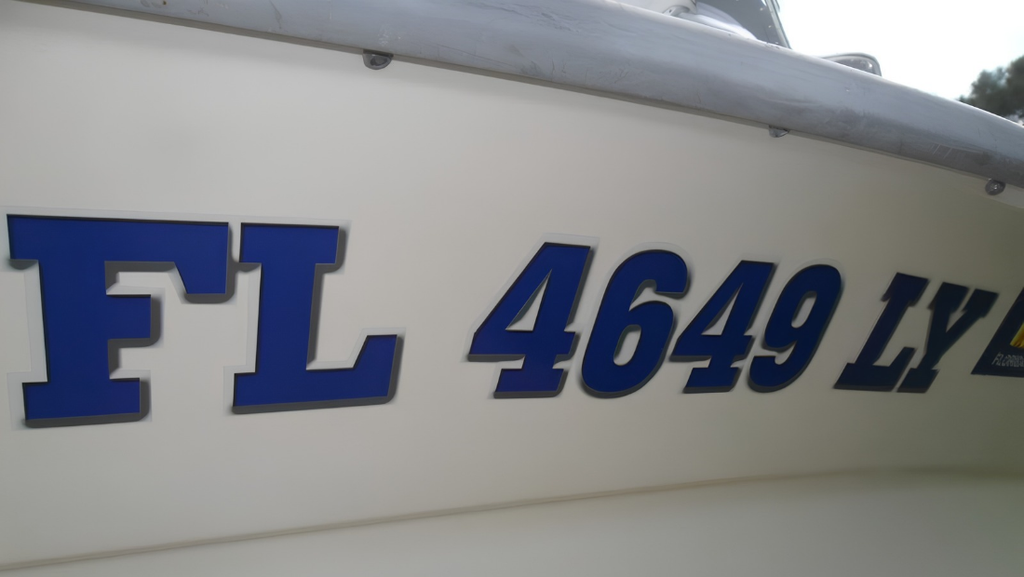
Once you have verified the registration number assigned to your boat, review the existing lettering. If the number is incorrect, damaged, missing, or difficult to read, you may need replacement lettering. At Vintage Marine Graphics, we create custom boat registration numbers using marine-grade vinyl and vessel-specific layouts.
Our work includes matching the assigned characters, preparing consistent spacing, and selecting lettering that complements the hull while maintaining readability. We can also help owners replace registration lettering after a refit or update the appearance of their boat.
The important distinction is that government agencies issue and maintain registration records, while marine lettering providers produce the physical numbers displayed on the boat.
FAQs
Can I look up Florida boat registration numbers for free?
Some Florida vessel-related searches are free, including the FDLE stolen-boat search. However, official registration and title record requests through FLHSMV may require fees. The appropriate method depends on the information you need.
How do I look up a Florida boat with registration numbers?
You can use the FL number when requesting available registration records through FLHSMV or checking the FDLE stolen-boat database. For title information, the agency may require the hull identification number or title number instead.
Can I find the owner’s name using a Florida boat registration number?
Ownership information may appear in certain official records, but access to personal details is restricted. You must follow Florida’s records-request requirements, and the agency determines which information it can release.
What if a Florida boat registration number does not match the title?
Compare the vessel’s HIN and other identifying details with the paperwork. If you cannot explain the discrepancy, contact the appropriate county tax collector or FLHSMV for guidance before completing an ownership transfer or ordering new lettering.
Expert Tip
Before ordering replacement registration numbers, compare the assigned FL number on the current registration certificate with the existing lettering on both sides of the boat.
Pay particular attention to similar-looking characters and any missing or damaged sections. A clear photograph of the current lettering, together with the verified registration number, can help a lettering provider prepare an accurate replacement layout.
Find the Correct Vessel Records Before Updating Your Boat
A Florida boat registration number lookup starts with choosing the right source. FLHSMV handles state vessel records, FDLE offers reported stolen-boat searches, and the U.S. Coast Guard provides information for vessels included in its federal systems. If you are buying or transferring a boat, review the available records and resolve any identification or ownership questions before proceeding.
Once you have confirmed the correct registration number, we can help with the physical lettering. Vintage Marine Graphics designs and installs boat registration numbers for owners who want a clean, readable layout that suits their vessel. You can start your boat lettering project by sharing your vessel details and registration lettering needs.