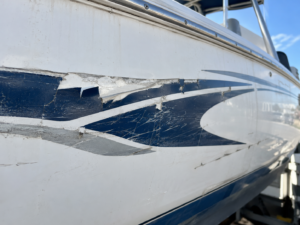

Yes, some stainless steel boat letters can be installed without drilling. For the right flat-cut lettering and mounting surface, we can use properly selected high-bond tape and specialty adhesive systems instead of putting holes in the transom.
At Vintage Marine Graphics, our Flat Cut Stainless installations may use marine-rated VHB systems, specialty marine epoxies, hidden fasteners, or custom mounting configurations. The right choice depends on the lettering design, mounting surface, curvature, exposure, and whether the project requires electrical wiring.
Quick Summary
- Drill-free installation can work for compatible flat-cut stainless steel lettering on a suitable, properly prepared mounting surface.
- We do not use a universal weight or thickness rule to decide whether adhesive mounting is safe.
- Illuminated, fabricated, unusually heavy, curved, or low-contact-area letters may require hidden fasteners or another custom mounting system.
- Surface preparation, alignment, adhesive selection, pressure, and cure or dwell requirements directly affect the finished bond.
Written by the Vintage Marine Graphics Team
At Vintage Marine Graphics, we design, fabricate, and install marine lettering for boat owners, captains, builders, and yards. Our work includes marine-grade 316 stainless steel lettering, custom boat lettering, illuminated lettering, graphics, and other vessel-specific fabrication. VMG’s founder, Kim Sutton, has worked through nearly five decades of changes in marine lettering methods and materials.
Our approach starts with the vessel rather than forcing every boat name into the same mounting method. We look at the transom, surface, dimensions, design, material, and installation requirements before deciding how the lettering should be secured.

Can Stainless Steel Boat Letters Really Stay On Without Drilling?
Yes. A properly designed adhesive mounting system can secure certain stainless steel letters without mechanical holes.
That does not mean ordinary double-sided tape is suitable. Drill-free mounting depends on the lettering design, available bonding area, mounting surface, curvature, expected movement, and the adhesive system selected for the project.
At Vintage Marine Graphics, our Flat Cut Stainless lettering systems may use marine-rated VHB systems, specialty marine epoxies, hidden fasteners, or custom mounting configurations. Drill-free installation is one available mounting approach when the boat and lettering design support it.
Drill-Free Stainless Is Different From a Vinyl Decal
A stainless boat name and a vinyl graphic may both involve adhesive, but they are different installations.
Vinyl is thin and flexible, while stainless is rigid and has a defined profile. A narrow script letter may also provide much less bonding area than a broad block letter of similar height.
That is why we evaluate the complete lettering design rather than treating stainless like an adhesive vinyl decal.
When Is Drill-Free Stainless Lettering a Good Choice?
Drill-free installation is most promising when the letters, mounting surface, and bonding system work together.
A typical candidate may have:
- Flat-cut, non-illuminated stainless steel lettering
- A smooth and stable mounting surface
- Adequate contact area behind each letter
- A surface compatible with the selected adhesive system
- Manageable curvature across the transom
- Clean areas free of wax, oxidation, oil, or loose coatings
- A layout that allows even pressure during installation
For example, consider a custom boat name with broad flat-cut letters going onto a smooth gelcoat transom. If the surface is sound and the letter backs provide enough bonding area, a properly designed VHB-and-adhesive system may allow us to create a clean installation without drilling the hull.
There Is No Universal Letter-Thickness Cutoff
We would not tell an owner that every letter below a particular thickness can be bonded and every letter above it must be drilled.
Letter thickness is only one variable. Total weight, shape, adhesive contact area, surface material, curvature, movement, and mounting configuration also affect the decision. According to 3M’s VHB Tape Design Guide, tape selection should account for factors such as the substrate, available tape area, thickness, movement, flexibility, and loading.
A thick but compact emblem can create a different mounting demand than a thinner script with long, narrow strokes. The design needs to be evaluated as a complete mounting system rather than by thickness alone.

When Are Hidden Fasteners or Mechanical Mounting a Better Choice?
Mechanical or custom hidden mounting becomes more attractive when adhesive bonding alone cannot provide the right installation for the design.
We pay closer attention when a project involves:
- Deep or fabricated dimensional letters
- Heavy individual characters or emblems
- Very narrow mounting surfaces behind the letters
- Strong or compound transom curves
- Uncertain paint or coating adhesion
- Textured or irregular mounting surfaces
- Stand-offs that hold lettering away from the hull
- Illuminated letters requiring wiring
- Locations where service access affects the design
Illuminated stainless lettering is an important example. Even when adhesive plays a role in the finished assembly, power cables still need a carefully planned route. Our illuminated stainless steel lettering is designed as a separate system because the lighting, depth, wiring, placement, and mounting requirements are more involved than a flat-cut non-illuminated name.

Drill-Free Does Not Automatically Mean Easier to Remove
Owners sometimes choose adhesive because they assume it can simply be peeled off later.
That is not always true. A high-strength bonding system is designed for durable attachment, so clean removal may require more work than owners expect. 3M publishes VHB tape removal procedures that address separating the bond and removing residual adhesive.
If future removability is important to your project, tell us before production. It may affect the recommended material and mounting method.
Adhesive vs. Mechanical Mounting for Stainless Boat Letters
| Mounting Method | Best Fit | Main Benefit | Main Limitation | What We Check |
| Marine-rated VHB and adhesive system | Suitable flat-cut, non-illuminated letters | Avoids unnecessary hull penetrations | Requires compatible surfaces and careful preparation | Surface, contact area, curvature, load, finish |
| Hidden or mechanical fastening | Fabricated, heavy, narrow, curved, or specialized letters | Adds physical attachment where the design requires it | Requires planned penetrations and access | Hull construction, backing access, hole locations |
| Custom mixed mounting system | Complex dimensional or vessel-specific designs | Lets us combine mounting methods around the actual project | Requires more planning before production | Letter geometry, hull, wiring, access, use |
The better way to choose is not “adhesive or drilling?” in isolation. We first determine what the boat name, logo, hull, and mounting location require.
Why Surface Preparation Matters So Much
A premium adhesive cannot compensate for a contaminated mounting surface.
Boat transoms may carry wax, polish, salt residue, oxidation, fingerprints, cleaning-product residue, or old adhesive. These contaminants can interfere with direct contact between the bonding system and the mounting surface.
3M’s VHB application guidance emphasizes proper surface preparation and application pressure. The exact preparation method still needs to be compatible with the boat’s paint, gelcoat, metal, or other finish.
Wax Is Especially Important
A transom may look clean while still carrying wax or polish. If the bonding system attaches to a removable surface layer rather than the underlying finish, the installation may be compromised regardless of the adhesive’s rated strength.
Along the Emerald Coast and Northwest Florida, salt exposure, sun, humidity, washing, and coastal storage make careful surface preparation especially important. These conditions do not automatically rule out drill-free installation; they make proper material selection and preparation more important.
How Do We Plan a Drill-Free Installation?
We prefer to make the mounting decision before the letters enter production.
1. Confirm the Boat and Mounting Surface
We start with clear photos, measurements, the intended location, and the surface material or finish. A straight-on transom photo is especially helpful.
Nearby hatches, vents, hardware, trim, outboards, and body lines can affect the usable space. We also check whether the surface has enough flat or gently curved area for the proposed lettering.
2. Match the Letter Design to the Installation
Font choice affects more than appearance.
A broad letter can offer generous mounting surface. A delicate script may have thin strokes and small adhesive areas. A custom logo can combine both conditions in the same design.
This is one reason our broader custom boat lettering guide emphasizes dimensions, surface condition, placement, and full-scale evaluation before production.
3. Use a Mounting Template to Establish Alignment
A full-size mounting template helps establish spacing, height, and alignment before a letter touches the hull.
Painter’s tape can temporarily hold the template or establish reference lines. We recommend viewing the proposed layout both close up and from a normal dock viewing distance before the mounting positions are finalized.
Alignment matters because a high-bond adhesive system may offer little opportunity to reposition a letter after firm contact.
4. Prepare the Mounting Surface
The surface needs to be clean, dry, stable, and compatible with the selected bonding system.
Preparation should follow the adhesive manufacturer’s instructions while also protecting the vessel’s finish. A cleaner, solvent, primer, or abrasive that works on one substrate may not be appropriate for another.
Avoid scraping a finished transom with a knife or using an aggressive chemical simply because the method worked on someone else’s boat.
5. Apply the Correct Pressure and Respect the Bonding Schedule
Pressure-sensitive tape requires firm, even application pressure to establish proper contact with the mounting surface.
Bonding and adhesive systems may also require specific dwell or cure periods before they should carry their intended load. Follow the requirements for the exact product being used rather than assuming one schedule applies to every system.
Does Drilling Automatically Damage a Fiberglass Transom?
No. A properly planned mechanical installation is different from casually drilling holes into a finished hull.
The concern is legitimate because the installer needs to know what lies behind the mounting surface. Wiring, plumbing, structural components, core material, and limited backing access can all affect where a hole should go.
When fasteners penetrate a cored fiberglass structure, the installation also needs to account for moisture protection around the penetration. WEST SYSTEM’s Fiberglass Boat Repair & Maintenance guide discusses bonding fasteners and protecting core material around hardware attachment points.
That does not mean every stainless letter requires this type of installation. It means drilling and sealing details should be planned as part of the mounting system whenever mechanical attachment enters a cored structure.
What About Stainless Lettering on a Curved Transom?
Curvature can change whether drill-free mounting is suitable.
A gentle, consistent curve may still provide adequate contact, while a compound curve can lift the edges of a rigid stainless letter away from the surface. If a letter contacts the transom in the center but not along its edges, simply adding more adhesive is not necessarily the answer.
In that situation, we may recommend changing the letter design, placement, fabrication, or mounting method.
What Common Drill-Free Installation Mistakes Should You Avoid?
The most common mistake is treating all adhesives, tapes, and surfaces as interchangeable.
Other problems include:
- Installing over wax, polish, oxidation, or other contamination
- Choosing an adhesive without checking surface compatibility
- Assuming every product labeled “marine” suits every hull finish
- Ignoring limited bonding area or strong transom curvature
- Installing before confirming spacing with a full-size mounting template
- Trying to reposition letters after a high-bond system has firmly contacted the hull
- Loading, washing, or stressing the installation before the specified bonding period
- Using aggressive scraping or chemicals without confirming they are safe for the finish
- Assuming every flat letter can be bonded or every thick letter must be drilled
A simple installation is valuable only when the system is appropriate for the custom project.
How Should You Choose the Right Mounting Method?
Start with the lettering you actually want and the boat you actually own.
If your goal is a clean, modern stainless boat name without visible attachments, we can evaluate whether our marine-grade 316 stainless steel lettering can use a drill-free or hidden mounting configuration.
We typically want to know:
- Your exact boat name or logo
- Boat make, model, and approximate length
- A straight-on photograph of the mounting location
- Available width and height
- Whether the surface is gelcoat, paint, metal, wood, or another material
- Whether the transom is flat or curved
- Your preferred stainless finish
- Whether the letters will be illuminated
- Any hatches, hardware, vents, or access limitations nearby
Those details give us a much better basis for a mounting recommendation than the word “stainless” alone.
You can also review our Flat Cut Stainless project gallery to see how dimensional stainless lettering is integrated into different vessel designs.

Frequently Asked Questions About Stainless Steel Boat Letters Installation
Is adhesive better than drilling for a fiberglass boat?
Neither method is automatically better. Adhesive can preserve an unperforated mounting surface on a suitable drill-free project, while mechanical or hidden fastening may be the better choice for other letter designs and installation conditions.
Can illuminated stainless boat letters be installed without holes?
An illuminated system normally needs a route for power wiring even if adhesive is used elsewhere in the mounting assembly. We therefore treat illuminated boat names as a separate installation problem and plan the wiring, mounting, spacing, and access together.
Can I install stainless boat lettering myself?
Some owners may be able to install a properly prepared system, but dimensional metal lettering leaves less room for alignment errors than a vinyl decal. When the transom is curved, the design is large, the finish is sensitive, or custom hardware or wiring is involved, professional installation can reduce the risk of alignment, preparation, and mounting errors.
Can adhesive-mounted stainless letters be removed later?
Yes, removal can be possible, but a high-bond installation should not be expected to peel away like temporary tape. The removal method depends on the adhesive system and the mounting surface, and improper removal can affect paint, gelcoat, or surrounding finishes.
Choose the Mounting System Before We Build the Letters
Stainless steel boat letters do not automatically require holes in the transom. Drill-free mounting can work for suitable flat-cut lettering when the design, bonding area, surface, and installation system are compatible.
If your project needs hidden fasteners, mechanical attachment, electrical wiring, or another custom solution, the best time to identify that is before fabrication begins.
Send us a straight-on photo of your boat, the available dimensions, your boat name or logo, and your preferred finish. Start your design with Vintage Marine Graphics, and we can evaluate the lettering and mounting conditions together.
You can also review our guide to stainless steel boat lettering and long-term durability before choosing your final material and finish.