
Yes. A boat transom can often be partially wrapped even when hardware and lettering are already in place, but the right approach depends on what is mounted there, how the surface is shaped, and where the new graphic needs to end.
This guide is for boat owners, captains, and marine professionals planning a partial transom wrap around brackets, handles, vents, access panels, vinyl lettering, or raised metal letters. We’ll explain what may need to be removed, what can sometimes stay, how curves and cutouts affect the design, and when surface repairs should come first. Planning these details before production helps reduce awkward seams, visible outlines, edge-lifting risks, and unnecessary rework.
Quick Summary
- We evaluate swim-platform brackets, handles, vents, drains, doors, and other hardware before finalizing a transom wrap layout.
- Existing vinyl graphics are normally removed from the area being wrapped so the new film bonds to a clean, stable surface.
- Raised metal lettering can often be incorporated into the finished design, but removal and reinstallation may be necessary when the partial wrap extends behind it.
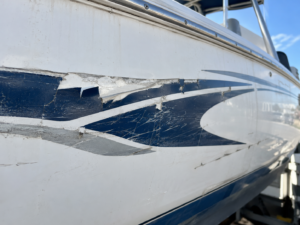
- Cracks, loose coatings, rough repairs, oxidation, or other unstable surfaces should be addressed before vinyl installation.
Written by the Vintage Marine Graphics Team
At Vintage Marine Graphics, we focus on marine lettering, original artwork, custom graphics, partial wraps, transom wraps, stainless lettering, and related vessel identification. Our transom wrap service is designed around the stern’s dimensions, curves, hardware, and visual proportions rather than treating the transom as one flat rectangle.
Our founder, Kim Sutton, has worked across painted, vinyl, printed, stainless, and illuminated marine graphics for nearly five decades. That marine-specific background shapes how we approach layout, production, and installation rather than simply making a graphic fit on screen.

Does All Transom Hardware Have to Be Removed Before Wrapping?
No. Not every piece of transom hardware must automatically come off, but removing hardware often gives us more usable surface and fewer exposed cut edges.
The correct choice depends on the fitting, how it is mounted, whether it can be safely removed, and where the graphic needs to end.
This is also consistent with current manufacturer installation guidance. In its official Watercraft Application Instruction Bulletin, 3M instructs installers to remove the rub rail and as much additional hardware as possible before applying its recommended watercraft films. The bulletin also provides specific preparation guidance for hardware that cannot be removed.
This is product-specific manufacturer guidance: 3M limits this bulletin to qualifying personal and recreational watercraft and excludes vessels used in commercial or business enterprises, so it should not be treated as a universal rule for every boat or film system.
Swim-platform brackets and substantial mounted hardware
Swim-platform brackets deserve special attention because they create several edges, fastener points, and difficult trimming areas.
If a bracket can be removed safely and the installation scope allows it, removing it can let the vinyl continue behind the mounting position instead of creating multiple exposed cuts around the bracket.
That does not mean we automatically unbolt every swim platform. Removing structural or load-bearing hardware may require appropriate mechanical knowledge, access from behind the transom, sealant replacement, or coordination with a marine technician.
If hardware removal is required, that scope should be established before installation rather than assumed after the graphic has already been produced.
Handles, grab rails, and small fittings
Small handles and similar removable fittings are often easier to plan around than large brackets. However, every mounting point still interrupts the wrap surface.
When the fitting can be removed without creating unnecessary risk, removal may provide a cleaner installation. When it must remain in place, the wrap can sometimes be trimmed around it with carefully planned edges.
The important part is deciding this before the artwork is approved. A handle sitting in the center of a fish illustration, boat name, or important color transition can disrupt the finished composition even if the installer can technically cut around it.
Vents, drains, and through-hull openings
We never want artwork to interfere with the function of a drain, vent, access point, or other working component.
These areas may require a controlled cutout with adequate clearance. The final edge location should keep the opening functional while avoiding unnecessary narrow strips of vinyl that are difficult to finish cleanly.
For example, if a fishing boat has two drains close to the lower corners of its stern, we may reposition a printed background or boat name slightly higher rather than forcing important artwork through those openings.
Can You Wrap Over Existing Vinyl Lettering?
For the area receiving the new wrap, we generally want the existing vinyl removed first.
Wrapping directly over old lettering can leave the shape of the letters visible beneath the new material. More importantly, the new wrap would be bonding partly to the old graphic instead of directly to the prepared transom surface.
Avery Dennison’s official marine wrapping application guidance instructs installers to remove unnecessary hardware, rigging, and pre-existing graphics before applying its marine wrap system.
Remove the adhesive residue too
Removing the visible vinyl is only part of the job. Residual adhesive, wax, polish, silicone, salt, oils, and other contamination can interfere with adhesion.
3M’s watercraft guidance calls for thorough cleaning immediately before application and specifically notes that marine wax can greatly reduce graphic adhesion. The surface must also be fully dry.
That is why we evaluate the exposed surface after old graphics come off rather than assuming it is immediately ready for a new transom wrap.
What About Existing Raised Metal or Stainless Boat Letters?
Raised letters can often be part of a finished transom design, but whether they stay in place depends on where the wrap needs to go.
If the partial wrap will cover the surface behind the lettering, the cleaner approach may be to remove the dimensional letters first, prepare and wrap the exposed surface, then reinstall or replace the lettering according to the approved design.

Vintage Marine Graphics offers marine-grade stainless lettering as part of our dimensional marine identification work, so the background graphic and lettering can be planned as one visual system rather than two unrelated additions.
Existing illuminated lettering requires more planning
Illuminated lettering can involve mounting points, wiring, backing components, and electrical connections.
In that situation, we want to understand exactly how the existing system is installed before designing behind it. Removal and reinstallation should be coordinated with whoever is qualified to service that particular system when electrical or structural work is involved.
You do not always need to remove the letters
If the wrap is intended only for the open area around an existing name, we may instead design a controlled boundary that leaves the letters untouched.
For example, a stainless boat name centered high on the transom might remain in place while a partial background graphic occupies a clean rectangular or shaped area below it.
The design decision comes first. We do not recommend adding seams and cutouts simply to avoid moving an obstruction when a cleaner layout is available.
How Do Access Panels and Transom Doors Affect the Wrap?
Access panels and doors should be treated as separate moving surfaces, not ignored underneath one continuous sheet of vinyl.
A graphic may visually continue across a panel, but the material still needs appropriate cuts around the moving edge. Otherwise, opening the panel can pull, crease, or damage the film.

We also need to consider:
- Hinges
- Latches
- Finger pulls
- Door gaps
- Weather seals
- Removable panels
- Engine-access openings
A good layout can make these interruptions feel intentional.
For example, a dark printed background might use an existing door gap as a natural design break. That is often cleaner than placing a narrow seam a few inches away simply to keep the artwork symmetrical.
Can You Wrap a Stepped or Curved Boat Transom?
Yes, many stepped and curved sterns can support a partial wrap, but the geometry determines how the film should be divided, stretched, trimmed, and finished. Vintage Marine Graphics specifically designs transom wraps for curved and stepped transom surfaces.
Curves matter because vinyl film has physical limits. 3M notes that complex curves require specialized application techniques and that stretched film retains some memory of its original shape. Proper post-heating helps reduce the tendency toward tenting or lifting around sharp contour changes.
Compound curves should not be solved by stretching harder
More stretch is not automatically better. A complex corner may need the artwork repositioned, a controlled seam, a relief strategy, or a different panel arrangement. For better edge stability and a cleaner installation, the goal is to keep unnecessary film stress away from critical edges.
The exact process depends on the selected film system, so installation temperatures, post-heating requirements, primers, and finishing procedures should follow the current manufacturer instructions.
Where Should Seams and Cut Edges Go?
Seams and cutouts should be planned where they can be finished cleanly and protected from unnecessary stress.
A transom may include body lines, swim steps, access doors, vents, trim, and several pieces of hardware. That means there may not be one ideal uninterrupted sheet shape.
We consider:
- Where the graphic naturally changes color or pattern
- Existing body lines
- Hardware positions
- Moving panels
- Sharp corners and recesses
- Areas close to spray and repeated washdown
- Whether the edge can be properly pressed and finished
Check the waterline before finalizing coverage. The 3M and Avery Dennison systems referenced in this guide specify above-waterline application. Other film systems may have different limitations, so the current technical bulletin for the actual product should control the installation plan.
Hardware Treatment Guide for a Boat Transom Wrap
The table below is a planning guide rather than a universal installation rule. The vessel, fitting, surface, and chosen film system still need individual review.
| Transom Component | Can It Sometimes Stay? | Preferred Planning Approach | Main Consideration |
| Existing vinyl letters or decals | Usually not within the coverage area | Remove graphic and adhesive residue | Old edges can remain visible and prevent direct bonding to the base surface |
| Raised stainless or metal letters | Sometimes | Remove if the wrap must continue behind them; otherwise design around them | Mounting method, studs, adhesive, wiring, and final alignment |
| Swim-platform brackets | Sometimes | Remove when practical or carefully define wrap boundaries | Multiple fasteners and cut edges make the area more complex |
| Grab handles | Sometimes | Remove when practical; otherwise precision-cut around them | Hardware can interrupt both adhesion area and artwork |
| Small vents | Often | Build a clean cutout into the installation plan | Vent opening must remain unobstructed |
| Drains | Often | Maintain adequate clearance and keep the drain functional | Avoid narrow vinyl edges around the opening |
| Access panels | Yes | Treat the panel and surrounding transom as separate moving surfaces | Door movement and hinge gaps |
| Stepped transom features | Yes | Design panel transitions around the actual geometry | Overstretching and awkward edge locations |
| Surface cracks or failing finish | No, not until addressed | Repair and stabilize the surface first | Vinyl is not a repair system |
Does the Surface Need Repair Before a Partial Transom Wrap?
Yes, when the existing surface is unstable, rough, cracked, peeling, or otherwise unsuitable for adhesion, it should be corrected before we wrap it.
A vinyl graphic follows the surface underneath it. It does not repair structural damage, loose coatings, failed gelcoat, deep gouges, or poor previous repairs.
Common surface problems we want resolved first
These can include:
- Chipped or flaking coatings
- Poorly bonded previous paint
- Rough fiberglass repairs
- Cracks that require proper evaluation
- Deep scratches or gouges
- Remaining adhesive from old lettering
- Heavy contamination or wax
- Uneven filler or repair edges
If the transom actually needs restoration, refinishing, or a permanent coating, our boat wrap vs. paint guide explains those broader options without turning this hardware guide into a paint comparison.
How Can the Boat Name Be Integrated Into the Transom Wrap?
The boat name should be designed at the same time as the transom artwork whenever possible.
We can build the name into a printed graphic composition or coordinate the background with separate lettering. Vintage Marine Graphics’ transom service specifically includes integrated boat names, logos, and artwork.
Printed into the artwork
A printed name can become part of the background itself.
This works well when the design uses:
- Illustration
- Gradients
- Shading
- Textures
- Complex colors
- Fishing-team artwork
- Logos
The advantage is complete control over the relationship between the name and the surrounding artwork.
Applied as separate lettering
Separate lettering can create a cleaner layered effect when the name needs to stand apart from the background.
For example, we might design a printed partial transom graphic first and then place contrasting vinyl lettering over it. Raised stainless lettering can create even more depth when the installation plan allows it.
Our boat decals vs. boat lettering guide explains the broader differences between printed graphics and lettering formats.
What about a teak transom look?
If you want a traditional wood appearance rather than a vinyl graphic, that becomes a separate design decision. Review our teak transom backgrounds before finalizing a wrap layout because the two approaches use different construction and installation methods.

What Should You Send Us Before We Design Around Existing Hardware?
Good photographs and dimensions allow us to solve many problems during design instead of discovering them during installation.
For a boat transom wrap, send us:
- A straight-on photograph of the entire transom.
- Wider photographs showing the swim platform, engines, stern corners, and surrounding hull.
- Angled photos showing steps and compound curves.
- Close-ups of every handle, vent, drain, bracket, access panel, and existing letter.
- Overall usable width and height.
- Measurements between major pieces of hardware.
- The exact boat name or wording you want included.
- Existing logo or artwork files, if applicable.
- Photos of cracks, repairs, oxidation, adhesive residue, or damaged gelcoat.
- Your vessel location and desired installation timing.
Our partial wrap service begins with reviewing the boat and the specific area to be covered. Designs are then refined and approved before production so sizing, alignment, and balance can be checked first.
If you are still planning the broader budget, use our separate boat wrap cost guide. For broader questions about vinyl systems and general durability considerations, review our marine vinyl boat wrap guide.
Frequently Asked Questions
Do swim-platform brackets have to be removed?
Not in every situation. We prefer to evaluate the bracket, mounting method, wrap coverage, and access before deciding whether removal or a carefully planned cutout provides the better installation.
Can a transom wrap go over an old boat name?
We generally remove existing vinyl lettering when the new partial wrap will cover that area. If the name uses raised metal letters, we evaluate whether they can stay outside the wrap boundary or need coordinated removal and reinstallation.
Can you wrap around a drain or vent?
Often, yes, as long as the opening remains functional and the film can be cut and finished properly around it. We may also adjust the artwork so important lettering or detail does not crowd the fitting.
Can a transom wrap cover damaged gelcoat?
A wrap should not be used as a substitute for repairing an unstable or damaged surface. We want the underlying transom smooth, clean, dry, and structurally sound enough for the selected graphic system before installation.
Expert Tip: Photograph the Transom With Every Door Open
Before sending your project photos, take one straight-on image with every access door and hatch closed, then take another with all of them open.
That second photograph often reveals hinge lines, hidden fasteners, wiring access, removable panels, and hardware depth that cannot be seen in the normal beauty shot. It gives us much better information for deciding where artwork, seams, and lettering should end.
Plan the Hardware Before You Finalize the Artwork
A successful partial transom wrap starts with the actual stern, not a blank digital rectangle. Handles, brackets, drains, doors, existing lettering, curves, and previous repairs all influence where the graphic should begin and end.
In some cases, hardware can stay. In others, removal produces a cleaner installation. The important step is to make that decision before we finalize the design, print the artwork, or establish critical edge locations.
For boat owners in Northwest Florida, we can review the transom, existing graphics, hardware, and design goal as one project. Browse our transom wrap service and partial wrap gallery to see how we approach targeted marine graphics.
When you are ready, use Start My Design & Installation and send us clear transom photos, measurements, your boat name or artwork, and close-ups of the existing hardware. We can then determine what should stay, what may need to come off, and how the finished partial wrap should fit the vessel.