
Summary
Florida boat registration numbers must be displayed on both sides of the forward half of the vessel in block characters at least three inches high, using a solid color that clearly contrasts with the hull. The numbers must read from left to right, remain visible above the waterline, and use proper spacing between letter and number groups; for an undocumented vessel, the state decal belongs on the port side within six inches of the registration number. This guide also explains approved lettering styles, installation steps, common mistakes, and the separate rules for federally documented vessels, based on current Florida and federal guidance.
Display Florida boat registration numbers on both sides of the vessel’s forward half using block characters at least three inches high. Read the numbers from left to right, choose a solid color that contrasts with the hull, and keep them clearly visible above the waterline. For an undocumented vessel, place the Florida registration decal on the port side within six inches before or after the registration number.
Quick Summary
- Florida registration numbers must be at least three inches high.
- Place the number on both sides of the forward half of the vessel.
- Separate the letter and number groups with a hyphen or a space equal to one letter width.
- For an undocumented vessel, place the Florida registration decal on the port side within six inches before or after the number.
Written by Vintage Multimedia Team
This guide was prepared by the Vintage Multimedia team and reviewed using current information from the Florida Fish and Wildlife Conservation Commission, the Florida Department of Highway Safety and Motor Vehicles, Florida Statutes, and federal vessel-documentation rules.
Vintage Marine Graphics founder Kim Sutton lettered his first boat at age 16 and has worked in marine lettering and graphic production for nearly five decades. Today, the team designs registration numbers, boat names, graphics, and custom marine identification for vessels ranging from skiffs to superyachts.
What Is a Vessel FL Number?
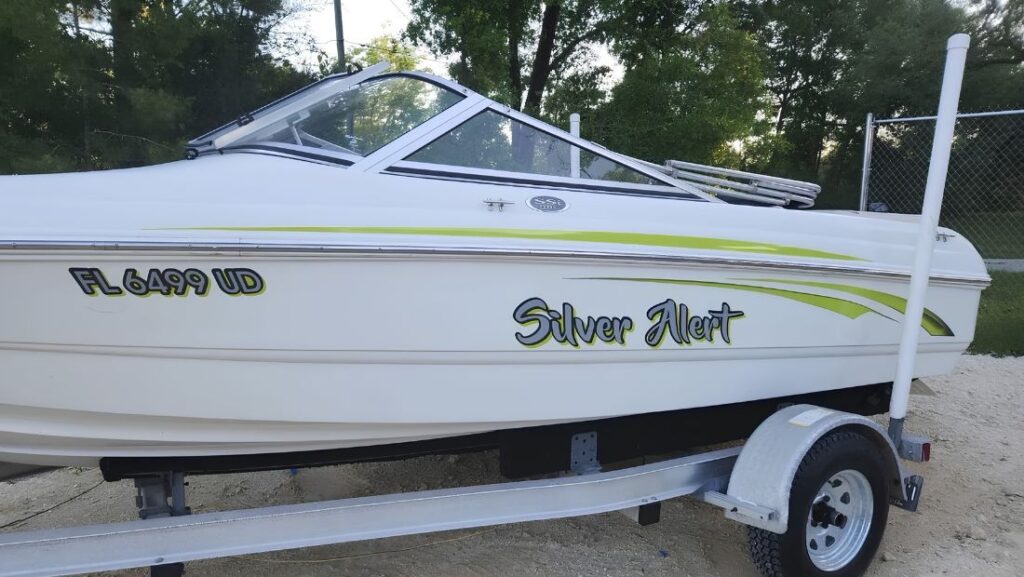
A vessel FL number is the registration number Florida assigns to a state-registered boat. It begins with “FL” and is followed by numbers and letters unique to the vessel. Owners must display the complete number on both sides of the forward half of the boat.
What Are the Florida Boat Registration Number Requirements?
Florida boat registration numbers must follow specific rules for placement, height, character style, spacing, color, and visibility. The displayed number must be the registration number assigned to the vessel and must remain clearly visible and legible for identification.
| Requirement | Florida rule |
| Placement | On both sides of the forward half of the vessel |
| Reading direction | From left to right |
| Minimum height | At least 3 inches |
| Character style | Block characters of good proportion |
| Color | One solid color that contrasts with the background or hull |
| Spacing | A hyphen or space equal to the width of a letter between the letter and number groups |
| Visibility | Clearly visible, legible, and displayed above the waterline |
| Airboats | Numbers may be displayed on both sides of the rudder |
| Registration decal | For an undocumented vessel, on the port side within 6 inches before or after the registration number |
These requirements are established under Florida vessel-registration law and reflected in current Florida Fish and Wildlife Conservation Commission guidance.
What Does a Florida Registration Number Look Like?
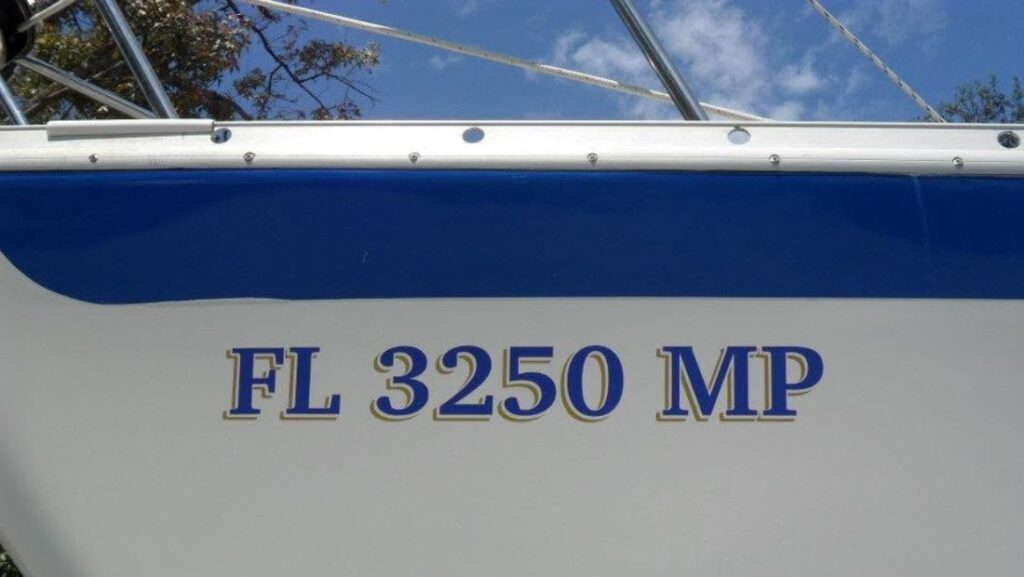
A Florida vessel registration number begins with the state abbreviation FL. It is followed by the numbers and capital letters assigned to the vessel.
Florida law allows registration numbers in either of these formats:
- Up to four numbers followed by two letters
- Up to three numbers followed by three letters
Compliant layouts may look like:
- FL 1234 AB
- FL-1234-AB
- FL 123 ABC
The number and letter groups must be divided by hyphens or equivalent spaces. Each separating space or hyphen must be equal to the width of a letter other than “I” or a number other than “1.”
Display the complete registration number exactly as it appears on the current registration certificate. Do not remove characters, change their order, shorten the number, or substitute another identification number.
Where Should the Numbers Be Placed?
Place the registration number on both the port and starboard sides of the vessel’s forward half. Keep the entire number above the waterline and clearly visible while the boat operates normally.
Do not place the number:
- On the transom
- On the rear half of the hull
- Below the normal waterline
- Where rails, hardware, bumpers, or graphics cover it
- Across a sharp body line that makes characters hard to read
For airboats, Florida allows the registration numbers to be displayed on both sides of the rudder.
Example: A center-console boat may have enough open space near the bow, but a rub rail or hull stripe could interrupt the number. The lettering should be moved to a clear surface rather than installed across the obstruction.
Where Does the Florida Registration Decal Go?
The state-issued registration decal goes on the port, or left, side of an undocumented vessel within six inches before or after the registration number. The decal shows the year or years for which the vessel registration is valid.
Only the port side receives the Florida validation decal. The starboard side still displays the registration number but does not receive a matching state decal.
Any previous-year decal must be removed before the vessel is operated on Florida waters.
Registration Number Versus Registration Decal
The registration number and decal have different purposes:
| Item | Purpose | Location |
| Registration number | Identifies the registered vessel | Both sides of the forward half |
| Validation decal | Shows the registration period | For an undocumented vessel, port side within 6 inches before or after the number |
The registration number can be produced as custom vinyl lettering. The official validation decal must come from the state as part of the vessel-registration process.
Which Vessels Need Florida Registration Numbers?
Most motorized vessels operating on Florida public waterways must be titled and registered. A purchaser of a vessel that must be registered has 30 days after the purchase to register and number it. During that period, the operator must keep the bill of sale aboard and available for inspection.
Florida provides several exceptions to the registration-number display requirement.
These include:
- Vessels used and stored only on private lakes or ponds
- Vessels owned by the United States Government
- Vessels used only as ship lifeboats
- Nonmotorized vessels under 16 feet
- Nonmotorized canoes, kayaks, racing shells, and rowing sculls
- Federally documented vessels
- Certain out-of-state vessels present for no more than 90 consecutive days
- Vessels operating under a valid temporary certificate
- Certain foreign vessels temporarily using Florida waters
- Undocumented vessels used only for racing
The full exceptions are listed under Florida Statute 328.56.
Do Personal Watercraft Need Registration Numbers?
Yes. Motorized personal watercraft, including Jet Skis and Sea-Doos, must be registered and display their assigned Florida registration numbers and valid decal.
The same basic rules apply:
- At least three inches high
- Block-style characters
- Strong contrast
- Both sides of the forward half
- Decal on the port side
Space can be limited on a personal watercraft, so the number may need to be planned around body lines, trim, handles, and factory graphics.
Are the Rules Different for Federally Documented Vessels?
Yes. A federally documented vessel does not display a Florida registration number. However, it may still need Florida registration and a Florida validation decal. FWC instructs documented vessels without an active state registration to obtain Florida registration and display the validation decal on the port side.
Florida law allows the decal for a documented vessel to be placed on the port side of the hull, a port-side window, or the port-side windshield.
Federal Name and Hailing-Port Rules
A recreational vessel documented with the U.S. Coast Guard must display its vessel name and hailing port together on a clearly visible exterior part of the hull. The markings must be durable, legible, and at least four inches high.
The federal official number follows a different rule. It must be permanently marked on a clearly visible interior structural part of the hull, preceded by “NO.,” using block-type Arabic numerals at least three inches high.
| Identification type | State-registered vessel | Federally documented vessel |
| Florida registration number | Displayed on both sides of the forward half | Not displayed |
| Florida validation decal | Port side near the number | Displayed on the port side when Florida registration is required |
| Vessel name | Optional unless another rule applies | Required |
| Hailing port | Not a state-number requirement | Required |
| Federal official number | Not applicable | Permanently marked inside the hull |
Boat owners should confirm whether their vessel is state-registered, federally documented, or subject to both state and federal requirements before ordering lettering.
What Font Can Be Used for Florida Boat Registration Numbers?
Florida requires block characters of good proportion. The characters must be easy to read and at least three inches high. Decorative scripts, thin typefaces, distorted lettering, and tightly compressed fonts should not be used for registration numbers.
Decorative lettering can still be used for:
- Boat names
- Custom logos
- Fishing-team graphics
- Charter branding
- Transom lettering
Keep those design elements visually separate from the official registration number.
Can Registration Numbers Match the Boat’s Design?
Registration numbers can complement the boat without becoming difficult to read. A clean block font and a carefully selected color can create a finished look while still meeting the display rules.
For example:
- Black lettering on a white hull
- White lettering on a navy hull
- Dark blue lettering on a light gray hull
- Cream lettering on a dark green classic hull
Avoid patterns, gradients, camouflage effects, or nearby graphics that reduce contrast.
What Material Is Best for Boat Registration Numbers?
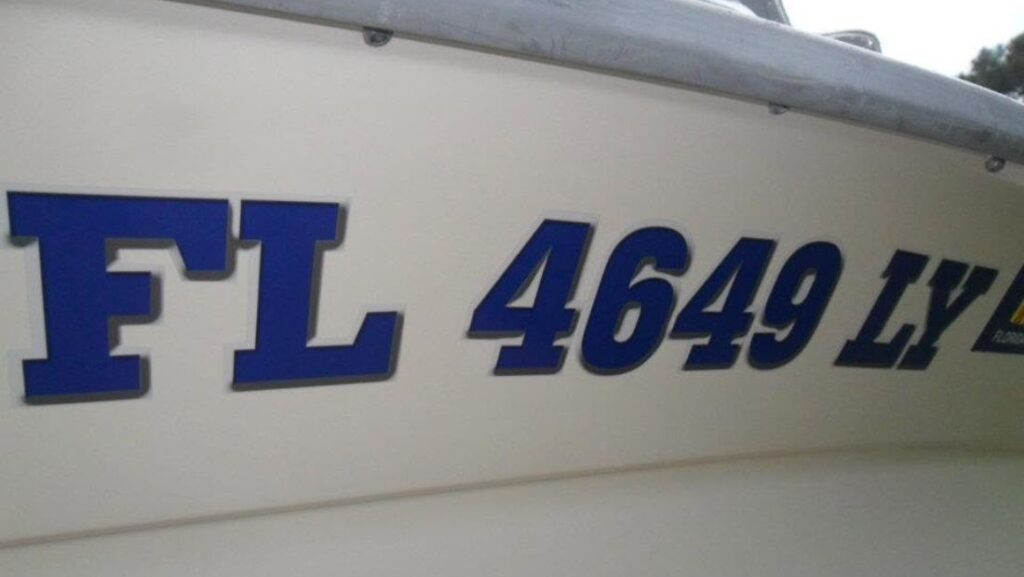
Marine-grade cut vinyl is a practical option for most smooth fiberglass, gelcoat, painted, and compatible aluminum surfaces. In addition, it creates clean edges and allows the entire registration number to be produced as one pre-spaced layout.
However, Florida does not require a specific lettering material. Registration numbers may be painted on or permanently attached, as long as they meet all size, placement, contrast, spacing, and visibility requirements.
Other options include painted numbers and separately installed characters.
| Option | Main advantage | Main consideration |
| Pre-spaced marine vinyl | Consistent alignment and easier installation | Surface must be clean and compatible |
| Individual vinyl characters | Easy to purchase | Each character must be measured separately |
| Painted numbers | Traditional appearance | Requires skilled surface preparation |
| Professional installation | Accurate spacing and placement | Adds installation cost and scheduling |
A pre-spaced layout keeps the complete registration number aligned on the transfer tape. This reduces the risk of uneven gaps between individual characters.
Why Surface Condition Matters
Even premium vinyl can fail when installed over:
- Wax
- Oxidation
- Salt residue
- Grease
- Loose paint
- Old adhesive
- Damaged gelcoat
A lettering provider should review the hull material and surface condition before production or installation.
How Do You Install Florida Boat Registration Numbers?
Start by confirming the exact number and identifying a clear area on both sides of the forward half. Measure and test the layout before removing the backing or applying individual characters.
Step 1: Confirm the Registration Number
Copy the number directly from the current registration certificate. Confirm every assigned letter and number. Separate the groups using either hyphens or spaces of the required width.
Step 2: Measure Both Sides of the Boat
Measure the available height and width on both the port and starboard sides. Do not assume both sides have the same usable space.
Step 3: Choose a Contrasting Color
Select dark lettering for a light hull or light lettering for a dark hull. View the color from several feet away before approving it.
Step 4: Prepare the Surface
Wash away dirt and salt. Remove wax, grease, and old adhesive with products approved for the hull finish. The surface should be clean, dry, smooth, and stable before application.
Step 5: Position the Full Layout
Next, use low-tack tape to hold the number in place. Then check the height, spacing, reading direction, alignment, and distance from nearby graphics.
Step 6: Apply the Lettering
Follow the vinyl manufacturer’s instructions for temperature, pressure, and application method. Apply the layout gradually without stretching the material.
Step 7: Add the Validation Decal
For an undocumented vessel, place the state-issued decal on the port side within six inches before or after the registration number. For a federally documented vessel that requires Florida registration, place the decal on the port side of the hull or on a port-side window or windshield. Remove expired decals as required.
What About Curved or Textured Areas?
Sharp curves, strakes, seams, rivets, and textured finishes can make vinyl installation more difficult. Therefore, moving the layout a few inches may produce a cleaner and more readable result.
Professional installation is worth considering when:
- The hull has heavy oxidation
- Old adhesive must be removed
- Access requires a lift or trailer adjustment
- The installation area is strongly curved
- Large factory graphics limit available space
How Do You Replace Old Boat Registration Numbers?
Replace registration lettering when it becomes faded, cracked, incomplete, loose, or difficult to read. A new number is also needed when the assigned registration changes.
Use gentle heat when removing old vinyl. Lift the material with a plastic tool rather than a metal scraper that could scratch the hull.
After removal:
- Clear away adhesive residue.
- Wash the surface.
- Remove wax or grease.
- Inspect the finish for oxidation or damage.
- Let the area dry fully.
- Measure the new layout before application.
Common Registration-Number Mistakes
Common problems include incorrect placement, poor contrast, decorative fonts, improper spacing, and rushed surface preparation.
Avoid these mistakes:
- Using characters under three inches high
- Installing the number on only one side
- Placing the number on the rear half of the boat
- Using cursive or heavily stylized lettering
- Selecting a color too close to the hull color
- Leaving too little space between character groups
- Placing the decal on the starboard side
- Installing vinyl over wax or oxidation
- Allowing graphics or hardware to cover part of the number
- Copying the assigned number incorrectly
A number can look attractive and still fail the display rules. Readability and proper placement must come before decorative styling.
What Information Is Needed to Order Registration Numbers?
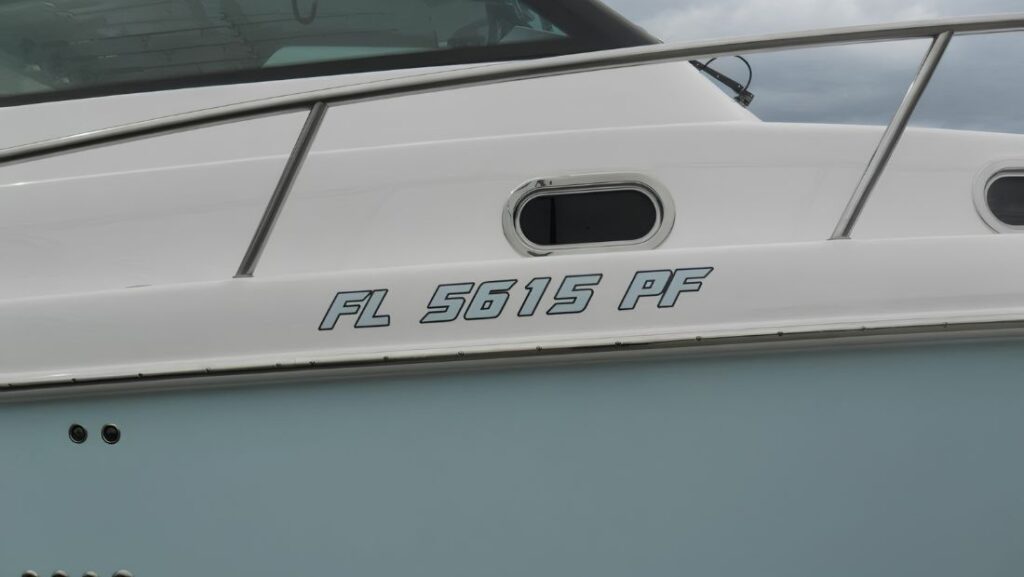
Provide the complete assigned registration number and clear photos of both sides of the vessel. Measurements and surface details help the lettering provider prepare an accurate layout.
Send:
- The complete Florida registration number
- Photos of the port and starboard sides
- Available height and width
- Hull color
- Hull material or finish
- Photos of nearby stripes or graphics
- Surface-condition details
- Vessel location
- Installation or shipping preference
- Requested completion date
Vintage Marine Graphics can prepare a proof showing the character height, spacing, color, and overall width before production. Same-day or next-day service may be available for simple registration-number projects, depending on the project details and current schedule.
FAQs
How tall do Florida boat registration numbers need to be?
Florida boat registration numbers must use block characters that are at least three inches high.
Can I use cursive letters for my Florida registration number?
No. Florida requires block characters of good proportion. Save cursive lettering for the boat name or decorative graphics.
Does the registration decal go on both sides of the boat?
No. The Florida validation decal goes on the port, or left, side within six inches before or after the registration number for an undocumented vessel.
Do Jet Skis and Sea-Doos need registration numbers in Florida?
Yes. Motorized personal watercraft must be registered and display their registration numbers and valid decal unless a specific legal exception applies.
Expert Tip
Before you produce the final lettering, create a full-size paper or low-tack-tape mockup of the entire registration number. Place it on both sides of the boat, step back, and inspect it from dock level.
This simple test helps you spot body lines, rails, shadows, or factory graphics that a close-up photo may not show clearly. Moving a paper layout is much easier than removing and replacing newly installed vinyl.